
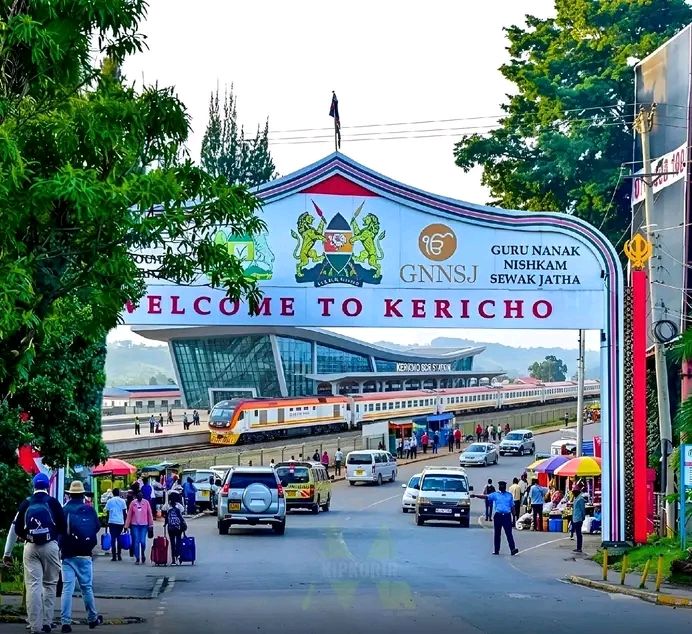
Tension is rising in Kericho County after hundreds of residents took to the streets in protest, accusing the government and Kenya Railways of altering the planned route of the Standard Gauge Railway extension without consultation. At the center of the dispute is Chebilat Terminal, a facility that locals say was promised to them as part of the original 2022 blueprint for the SGR and is now at risk of being bypassed entirely.
The demonstration, which brought together farmers, business owners, and community leaders, reflects growing frustration in the South Rift region over what many describe as broken commitments and a threat to long-term economic development.
According to protesters and community representatives, the Chebilat Terminal was earmarked to serve as a key logistics point for the region’s dominant agricultural sectors: tea, dairy, and horticulture. The facility was not just another station on the map. It was presented as a cost-cutting solution for farmers who currently rely on expensive road transport to move perishable goods to Nairobi, Mombasa, and export markets.
Beyond freight, residents were told the terminal would create direct employment opportunities for South Rift communities from cargo handling and warehousing to supporting services around the station. For many households in Kericho and neighboring Sotik North, the project represented a chance to tap into national and international markets without the bottlenecks of poor roads and high fuel costs.
That is why news of a revised alignment has landed so badly. Residents allege that the new route design will skip Chebilat altogether, reducing it to a mere passing point rather than a full terminal with loading, storage, and passenger facilities.
“We were shown plans. We were engaged. We surrendered our land because we believed in this project,” one protester told the crowd. “Now we are hearing the route has changed, and we will not accept it.”
The SGR extension has been discussed for years as the next phase of Kenya’s flagship rail project. The initial proposal released around 2022 positioned the South Rift corridor as a priority, with Chebilat and Sotik North listed among stations that would anchor rural economic growth.
For communities along the proposed line, that announcement triggered a chain of events. Families were asked to give up portions of land to make way for the railway reserve. In many cases, residents say they complied in good faith, vacating farms and waiting for compensation that has been slow to arrive.
The expectation was clear: sacrifice now for infrastructure later. But the alleged change in alignment has thrown those expectations into doubt.
Protesters argue that downgrading Chebilat to a passing loop effectively erases the economic justification for the land acquisition. A passing point offers little to no benefit to local farmers or traders. It does not provide cold storage for milk. It does not create jobs. It does not reduce transport costs for tea factories.
“Why should we lose land for a train that will not stop here?” asked another resident during the march. “That is not development. That is exclusion.”
To understand the intensity of the backlash, it helps to look at what Kericho and the wider South Rift contribute to Kenya’s economy.
Kericho is the heart of Kenya’s tea industry. The county produces a significant share of the country’s black tea, much of it destined for export. Tea factories in the region move thousands of tons every month, and transport costs eat deeply into farmers’ earnings.
The region is also a major milk-producing zone. Dairy cooperatives collect milk daily from smallholder farmers, but delays on the road often lead to spoilage. A rail terminal with refrigeration could change that equation entirely.
Horticulture is the third pillar. Vegetables and flowers from South Rift farms are increasingly finding buyers in Nairobi and beyond, but getting them there quickly and affordably remains a challenge.
The Chebilat Terminal was supposed to address all three. By connecting directly to the SGR, farmers would have a cheaper, faster, and more reliable way to get goods to market. The terminal would also anchor ancillary businesses: packaging, cold chain services, mechanics, food vendors, and transport operators. For a region where youth unemployment remains high, those jobs matter.
Bypassing Chebilat, residents argue, would concentrate benefits in other hubs while leaving South Rift to continue bearing high logistics costs.
Another layer to the protest is the issue of land and compensation. Several speakers during the march said many families had already signed over land after being assured the railway would pass through Chebilat.
To date, some are still waiting for payment. Now, with rumors of a route shift, they fear they may have given up land for nothing, or that compensation rates will not reflect the new reality.
This has eroded trust. Residents are asking not just for the original route to be reinstated, but for transparency from both the government and Kenya Railways on how and why the alignment would be changed.
The protesters’ demands are straightforward. First, they want the authorities to honor the 2022 plan that included Chebilat Terminal as a full-service station. Second, they are rejecting any move to downgrade planned stations into passing points without proper engagement. Third, they are calling for expedited compensation for all those who surrendered land.
Community leaders who addressed the crowd said they will escalate the matter through elected representatives, county government channels, and if necessary, through further peaceful demonstrations.
As of now, Kenya Railways has not issued a detailed public statement addressing the specific claims about Chebilat and Sotik North. The broader SGR extension project remains a key part of the government’s infrastructure agenda, with the goal of linking more counties to the rail network and reducing the cost of doing business.
But for infrastructure to succeed, it needs public buy-in. The Kericho protest is a reminder that communities watch closely when promises are made about development projects, especially when land and livelihoods are involved.
For the residents of Chebilat and Sotik North, the stakes are personal. This is about more than a railway line. It is about market access for tea farmers, cold storage for milk, jobs for young people, and the belief that national projects should benefit the people whose land they pass through.
Until there is clarity, the message from Kericho is unlikely to fade. “Restore Chebilat. Restore Sotik North.” For now, that is the demand and the line in the sand.



Comments
No approved comments yet. Be the first to join the conversation.