
MOMBASA — A modest group of demonstrators gathered in parts of Mombasa on Monday to observe the annual Saba Saba commemorations, an event in Kenya’s political calendar remembered for pushing democratic reforms in the early 1990s.
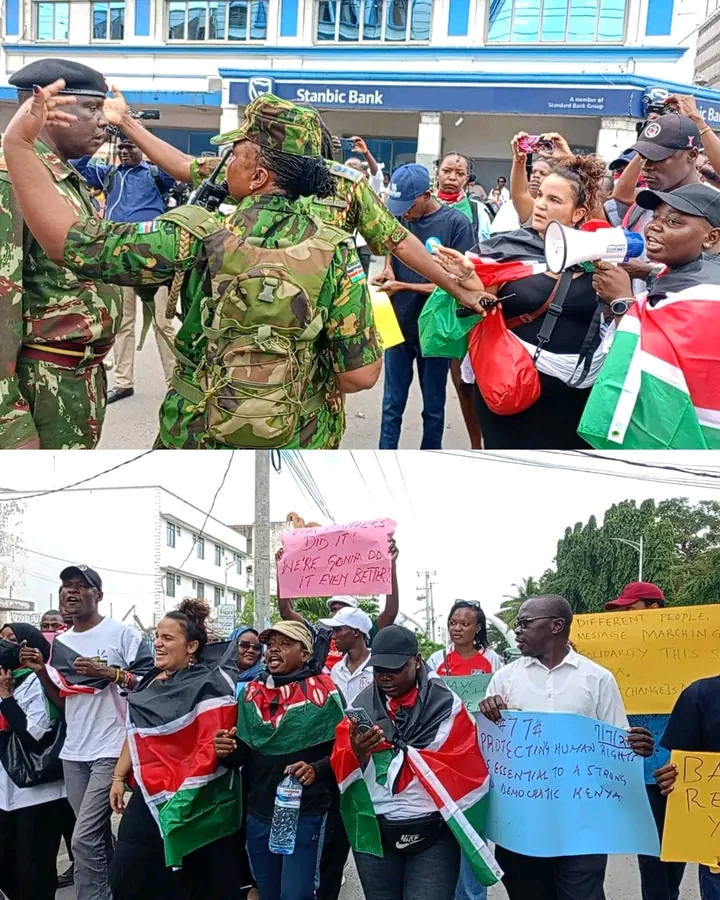
The turnout in the coastal city was limited compared to previous years, but the march still drew attention as participants moved through central streets waving Kenyan flags and holding placards. Security was visibly heightened, with police officers in anti-riot gear stationed at key junctions and outside major buildings, including banks and government offices.
Photos from the demonstration shared online showed men and women walking along city roads, some draped in the national colors. A few carried handwritten signs with political messages, while others used a megaphone to address the group as they walked. Officers in camouflage uniforms walked alongside the procession, monitoring the crowd and directing traffic to allow the march to continue without major disruption.
The Saba Saba date, July 7, marks the 1990 rally at Nairobi’s Kamukunji grounds that called for multi-party democracy. Over the decades it has evolved into a day when Kenyans across the country reflect on governance, civil liberties, and accountability. In recent years, the day has also been used by various groups to raise current social and economic concerns.
Book this slotUnlike past Saba Saba events that drew large crowds in Nairobi and other towns, this year’s gathering in Mombasa appeared to involve only a few dozen people. Witnesses said the protesters assembled in the central business district in the morning before moving through select streets.
Business activity in the areas around the march continued largely as usual. Shops remained open, matatus operated on their routes, and there were no immediate reports of property damage or confrontations. The heavy police deployment, however, meant that movement in some parts of the CBD was slower than normal as officers set up barricades and checked vehicles.
One participant told onlookers the goal was to “remember the struggle” and to remind leaders that citizens are still watching how public resources are managed. Others said they were using the day to speak out about the cost of living, youth unemployment, and service delivery at the county level.
The National Police Service had earlier indicated it would ensure public order during the commemorations. In Mombasa, that translated to a visible presence from the start of the day. Officers were stationed outside financial institutions such as Stanbic Bank, at roundabouts, and along Moi Avenue and Nkrumah Road.
Book this slotNo arrests were reported during the Mombasa procession. Police commanders in the county have in past statements said they support peaceful assembly as long as it does not interfere with public safety or destroy property. On Monday, officers were seen speaking with organizers and guiding the group away from congested intersections.
The approach reflected a broader national pattern this year, where authorities allowed small gatherings to proceed under supervision while discouraging activities that could lead to chaos.
For many Kenyans, Saba Saba is less about recreating the mass protests of 1990 and more about civic reflection. Civil society groups often use the date to publish scorecards on government performance, while young people use social media to debate policy issues.
In Mombasa, some of the placards carried messages touching on local concerns. Residents have in recent months raised issues around water supply, housing, and the cost of transport. The coastal economy, which relies heavily on tourism and the port, has also been affected by global inflation and changing trade patterns, factors that often come up in public discussions.
Book this slotA political analyst based in Mombasa noted that the smaller crowd did not necessarily mean less interest in governance. “People are expressing themselves in different ways now,” he said. “Some come to the streets, others engage online, others go through community forums. The key thing is that July 7 still prompts a conversation about accountability.”
The images from Mombasa circulated widely on Facebook and WhatsApp, with the post attracting hundreds of reactions and comments within hours. Many users discussed the meaning of Saba Saba today, while others commented on the police presence.
The post was credited to photographer John Chesoli. By mid-afternoon it had more than 550 likes and dozens of shares, indicating that even a small physical gathering can generate significant online engagement.
Some commenters praised the protesters for turning up peacefully. Others questioned whether street demonstrations remain an effective way to influence policy, arguing that sustained engagement with county assemblies and parliament might yield more results.
Book this slotThe first Saba Saba rally was held on July 7, 1990, when pro-democracy activists defied a ban to demand political pluralism. That event is credited with accelerating the repeal of Section 2A of the constitution and the eventual return of multi-party politics in 1991.
Since then, the date has been marked in different ways. In some years it has been a day of large protests. In others it has been quieter, with civil society holding debates, memorials, and voter education drives. The variation often depends on the political climate and the issues dominating public discourse at the time.
This year’s commemoration comes as the country continues to debate fiscal policy, devolution funding, and youth employment. Those topics were echoed in some of the messages seen in Mombasa, where protesters linked national democratic gains to current expectations for service delivery.
County officials in Mombasa did not issue a formal statement on the march, but traffic police later cleared the barricades and normal flow resumed in the CBD by early afternoon.
Book this slotOrganizers of the small procession said they did not plan to escalate the action and that the point was symbolic. “We came out to mark the day, to remember, and to say we are still here as citizens,” one organizer was heard telling the group before it dispersed.
Security agencies said they would remain on alert through the week but that there was no indication of further large gatherings in the county.
For Mombasa, the day ended without incident. The low turnout contrasted with the high symbolism of the date. Yet the images, the flags, and the conversations that followed online show that Saba Saba continues to serve as a moment for Kenyans to take stock of where the country is and where it is headed.
As one veteran activist put it in a separate interview earlier this week: “The crowd size changes, but the question remains the same. Are we delivering on the promises that people fought for?”
Book this slotIn Mombasa on Tuesday , a handful of voices answered that question on the streets, under watchful eyes and with the Indian Ocean breeze behind them.
Comments
No approved comments yet. Be the first to join the conversation.