
“We Have no Money” Excuse
Recently, I had argued that Africa’s development model has a sequencing problem where we sent presidents to Beijing, Baku, and Davos to hunt for capital before considering a count of what we already have. While president Ruto was courting SOCAR for a refinery in Kenya, transport workers struck over fuel prices at home is a ironic illustration considering that the continents sits on oil and has to beg to refine it. The Dangote Refinery was the $20 billion counter-example, largely African-sourced, betting that value addition can happen here rather than being imported back at a markup.
A second capital perspective sits on the 2026 African Development bank’s economic outlook report that undercuts the “we have no money” excuse even more directly than illicit flows or mispriced risk. For decades, discussions about development finance have revolved around foreign direct investment, aid, Eurobonds, or the latest financing package negotiated with multilateral institutions. Yet one of Africa’s largest and most reliable sources of capital rarely receives the strategic attention it deserves, the African diaspora.
Book a Mid-Article Native AdDesktop: Fluid (728x90) · Mobile: Fluid (300x250)A Bigger River than anyone advertises
We often celebrate remittances as acts of family generosity when capital crosses over every month from a nurse in Manchester, a driver in Doha, a software engineer in Austin, often treated as pocket money rather that necessary capital. Remittances to Africa reached $104.8 billion in 2024, up from $11.4 billion in 2000, a nearly tenfold increase in a generation, growing at an average 9.7 percent a year. That makes diaspora money the continent’s single largest source of external finance, ahead of both official development assistance and foreign direct investment combined.
“This erodes the net value of transfers making room for informal channels, like Hawala, which still account for hundreds of billions of shillings annually”
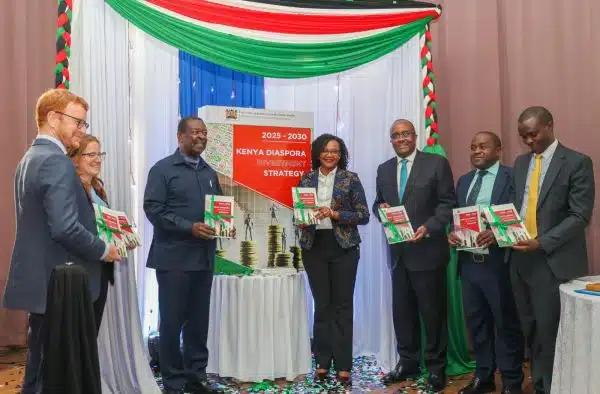
The African Development Bank identifies Nigeria, Kenya, Egypt, Senegal, and The Gambia as Africa’s strongest performers in mobilizing diaspora capital. Closer home, Kenya is not a bystander on these statistics. Kenyans abroad sent home $5.0 billion in 2024, at an average of $9,251 per diaspora member, the second-highest rate on the continent after Nigeria, and higher than Egypt’s. This is a figure more than four times Africa’s average GDP per capita where a relatively smaller diaspora of 540,000 Kenyans is outperforming countries with diaspora populations many times larger.
Book a Mid-Article Native AdDesktop: Fluid (728x90) · Mobile: Fluid (300x250)This reflects deliberate public policy with dedicated diaspora institutions, lower transfer costs, stronger financial inclusion, clearer investment instruments, and greater confidence in formal financial channels. With roughly US$5 billion in annual remittances and among the continent’s highest remittances per diaspora member, Kenya demonstrates that good policy matters. The country has a national diaspora policy which has focused on reducing transfer costs, formalizing flows, and strengthening financial inclusion rather than merely celebrating remittances during festive seasons.
Why some harvest this and others don’t
The AfDB’s comparison of “champion” and “under-mobilising” countries kills the lazy explanation that diaspora wealth is just a function of how many nationals live abroad or how rich the host countries are. Nigeria, Kenya, Egypt, The Gambia, and Senegal lead the continent not because their diasporas are the largest, but because their states built the plumbing to receive the money seriously. Nigeria stood up a dedicated diaspora commission and structured financial instruments while Kenya adopted a national diaspora policy focused on cutting transfer costs and formalizing flows. Egypt fixed its foreign exchange framework so people stopped routing money through informal channels. Moreover, Senegal built a dedicated investment fund for its diaspora while The Gambia designed products specifically for diaspora investors.
In comparison, nations like Sudan, Algeria, and the DR Congo has sizeable diasporas that remain badly underutilize. If the fifteen under-performing countries simply matched what the top five already achieve per diaspora member, Africa would generate an additional $92.1 billion a year. This is more that the continent’s entire annual haul of official development assistance, sitting untapped not because the money or the goodwill isn’t there, but because the institutions to receive it professionally aren’t.
This underscores my earlier claims, restated with different numbers, that the constraint on African capital is rarely the absence of African wealth. Rather, this is due to the absence of institutions willing to treat that wealth as something worth building infrastructure around.
A Case for Taking this More Seriously
Compared to SOCAR or Gulf Sovereign funds, reports by the World Bank and the IMF among others indicates that diaspora remittances are roughly three times less volatile than foreign direct investment and portfolio flows. When a state’s fiscal position wobbles, or a region turns politically hot, FDI is designed to run first. Remittances, by contrast, tend to hold or even rise during crises, because they are sent by people with an emotional stake in the outcome, not a portfolio manager’s mandate. Thus, In fragile and conflict-affected economies, diaspora money is frequently the thing standing between a household and destitution when everything else, including state capacity, and private investment is retreating.
If the AfDB’s growth trajectory holds, diaspora remittances to Africa could reach $179 billion by 2030, $433 billion by 2040, and cross $1 trillion by 2050. That is not a rounding error next to the refinery deals and mining concessions that dominate our headlines. It is a financing base larger and steadier than most of what our finance ministers fly abroad to negotiate.
This is why the African Development Bank argues that governments should integrate diaspora finance directly into national development strategies. That means developing diaspora investment funds, expanding savings and investment products linked to remittances, issuing well-governed diaspora bonds, and creating community financing vehicles that allow Africans abroad to invest directly in local infrastructure and productive enterprises.
From Pocket Money Remittance to Investment
The honest caveat is that remittances as currently structured across Africa mostly fund consumption in form of school fees, rent, and medical bills which is valuable and dignified but not, by itself, industrial capital. The countries doing this well have started converting some of that flow into investable capital rather than leaving it as a one-way transfer. Nigeria’s patriotic and citizen bonds lets diaspora lend directly to the state while Senegal’s Support Fund for Investment by Senegalese Abroad puts remittances into productive ventures rather than just household budgets. While these are still early and imperfect instruments, they ask the right questions on how Africa can get more people to send money home and how to get what is already send to compound as opposed to simply being spent.
While Kenya’s diaspora policy has done the harder-than-it-sounds work of formalizing channels, transfer costs still remain high with 83.3% of remittance recipients citing high transaction costs as a major barrier. This erodes the net value of transfers making room for informal channels, like Hawala, which still account for hundreds of billions of shillings annually, precisely because migrants seek to bypass exorbitant formal banking fees. The framework is also missing diaspora bonds tied to specific and transparent infrastructure projects for instance where Kenya, Uganda, and Tanzania issue diaspora-targeted instruments to their own citizens abroad backed by credible governance and real project economics. This is Davos and Baku discussions competing for the same $9,251-per-person pool that already proved it shows up reliably every year, recession or no recession.
The Capital was Never the Problem
Between illicit financial flows, distorted risk premiums, corruption, and now underused diaspora capital, Africa is leaving hundreds of billions of dollars a year on the table that require no foreign minister’s signature to unlock. The continent is religiously in need of institutions that are capable of receiving money as seriously as the diaspora that sends it. With this, Global capital will keep flowing into African Capital as argued before. However, while the diaspora is already showing up for motherland, the question, again, is whether our governments will build something worth investing in before asking anyone else to. More critically, are African governments ready to treat that capital as the strategic development asset it has already become.
Comments
No approved comments yet. Be the first to join the conversation.