
Standards Disabling Intra-Africa Trade
As Africa’s standards chiefs meet in Mombasa to sell the continent on “One Certificate,” the real obstacle to a single African market isn’t a missing standard but a missing trust architecture that only markets can build one at scale. Picture a small agro-processor in Machakos who spends weeks and a slice of working capital getting tomato paste certified fit for sale in Kenya, only to be find at Namanga that Tanzania’s food regulator will not recognize that Kenyan test result. The same jar, same recipe, same product leads to a second certificate, a second fee, and a second queue.
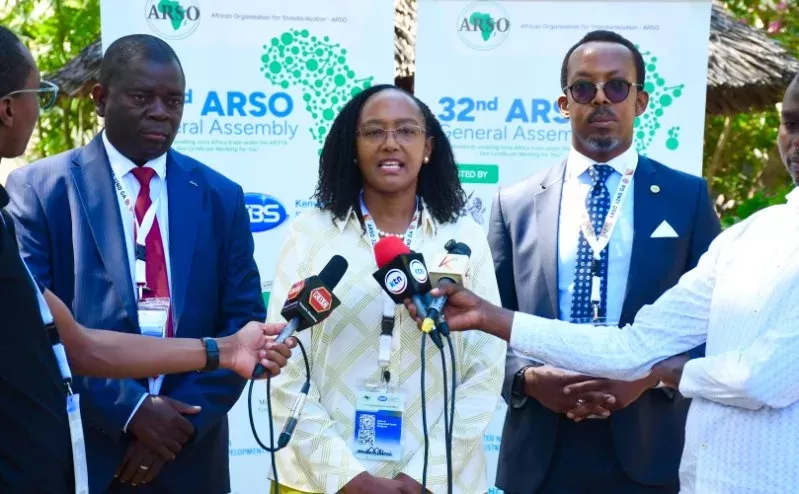
Multiplying this by the millions of small manufacturers, processors and cross-border traders scattered across the continent, it results in real, unglamorous face of everything the African Continental Free Trade Area still has to fix. That is the problem the 32nd General Assembly of the African Organisation for Standardisation (ARSO) gathered to solve this week in Mombasa. Hosted under the theme “Standards Enabling Intra-Africa Trade under the AfCFTA: One Certificate Working for You”, it raises a critical question on whether the one certificate can graduate to a lived reality.
Book a Mid-Article Native AdDesktop: Fluid (728x90) · Mobile: Fluid (300x250)A maze of conflicting testing and certification regimes
Deputy President Kithure Kindiki reminded delegates that AfCFTA promises a market of roughly 1.3 billion people and a combined economic output of $3.4 trillion. However, it’s notable that this promise is being undercut by a maze of conflicting testing and certification regimes. Speakers righty insisted that the “One Standard, One Test, One Certificate Accepted Everywhere” has to graduate from slogan to lived trade reality.
On paper, the technical case is already made as ARSO has harmonized more than 2,100 standards across the continent. Nine countries, including Cameroon, Egypt, Ghana, Kenya, Mauritius, Namibia, Rwanda, Tanzania and Tunisia, are piloting AfCFTA’s Guided Trade Initiative across 96 identified commodities. Moreover, where financing has been deliberate, harmonization has moved fast. Afreximbank-backed automotive standards grew from an initial target of 18 to 42 by 2021 and to 139 by mid-2025, enough that a battery built to specification in South Africa can now be fitted into a Kenyan bus without re-certification. Writing shared standards, it turns out, is the easy part.
The hard part is what happens after the standard is written. A shared technical document and a Nigerian regulator’s willingness to accept a certificate stamped by a Kenyan lab are two entirely different acts of faith. The first is a paperwork exercise. The second asks a sovereign regulator to stake its own credibility on an inspector it did not train, a laboratory it does not audit, and an enforcement culture it cannot control. That is not a standards problem but a trust problem, and Africa has spent decades discovering that trust between governments does not scale the way trade agreements assume it will.
Book a Mid-Article Native AdDesktop: Fluid (728x90) · Mobile: Fluid (300x250)Lessons and Failures from Regional blocs
The evidence is sitting inside Africa’s own regional blocs. The East African Community has operated a Common Market Protocol and a non-tariff-barrier monitoring mechanism for well over a decade, among just eight member states bound by a customs union and a shared court. Yet TradeMark Africa’s 2024–25 reporting shows EAC-related non-tariff-barrier complaints rising, not falling. 47 complaints were logged by mid-2025 alone, driven largely by uneven enforcement of the very standards the bloc had already agreed to harmonize. If mutual trust between regulators is still this fragile inside one of Africa’s tightest regional blocs, expecting it to hold cleanly across all 54 AfCFTA signatories, negotiating certificate-by-certificate and sector-by-sector is concerning.
“What it lacks is independence in the form of a mark that is genuinely opt-in, funded by the industries that use it rather than by donor cycles, and backed by real product-liability weight.”
A continental system built on states individually vouching for one another’s conformity-assessment bodies is a combinatorial problem. Fifty-four countries generate about 1,431 possible bilateral trust relationships, each one hostage to its weakest, least-resourced, or most protectionist pair. This is the part the Mombasa communiqués tend to skip. Certainly, the “One Certificate” ambition cannot be built the way tariff schedules are built, treaty by treaty, ministry by ministry. Trust of that kind does not travel through diplomatic channels but rather through brands, marks and reputations that businesses and consumers choose to rely on because the cost of being wrong falls on the certifier, not on the taxpayer.
A Mark of Liability and Goodwill
Africa needs not invent this model but to trust it. Long before governments regulated electrical safety, Underwriters Laboratories built the UL mark in the United States by insuring manufacturers against the cost of certifying a faulty product. This mark carried liability, not just goodwill, so buyers didn’t need to trust every factory, only the mark. Lloyd’s Register did the same for shipping a century earlier. ARSO already has the embryo of an African equivalent in the ARSO Quality Mark unveiled at the Mombasa gathering. What it lacks is independence in the form of a mark that is genuinely opt-in, funded by the industries that use it rather than by donor cycles, and backed by real product-liability weight. This will ensure that a certificate earned in Kigali means something in Accra without a phone call between two trade ministries first.
The economics of getting this right are large enough to justify the redesign. ARSO estimates AfCFTA could stimulate up to $35 billion in additional intra-African trade a year, with fair, harmonized implementation lifting intra-African trade by as much as 52.3 percent through duty elimination alone. Figures reported in 2026 suggests that full standards harmonization, layered on tariff liberalization, could raise intra-African manufacturing trade by up to 39 percent, with even larger gains in agriculture. Early pilots already show what “certify once” is worth in practice: Afreximbank data from 2025 point to export-documentation costs falling by up to 35 percent for firms using harmonized procedures savings that matter most to the small-scale, often women- and youth-led traders. Africa’s Trade Policy Training Centre identifies as the group hit hardest by duplicated testing and inconsistent enforcement.
Testing and Certification on the Continent
None of this works if it is rushed, as Africa still needs to strengthen its testing infrastructure so that products can be tested and certified on the continent to begin with. A trust mark is worthless if the laboratories behind it are under-equipped, because “one certificate” then just means one loophole, exploited through whichever regulator asks the fewest questions. Thus, any redesign of ARSO’s mark toward a market-funded, liability-bearing model has to be paired with continued investment in accredited African testing capacity. Otherwise the continent will have simply built a faster route for the same old problem.
Mombasa’s real test is not whether delegates can agree on another communiqué restating “One Standard, One Test, One Certificate.” Africa has been restating that ambition since at least the 29th ARSO General Assembly in Kinshasa. The test is whether ARSO and the AU are willing to let a certification mark behave like a market institution that is self-financing, insured, answerable to the businesses and consumers that rely on it. This is compared to another intergovernmental promise waiting on 54 capitals to individually make good on it. If the continent gets the redesign right, the tomato-paste processor in Machakos will clear the Namanga border once. If the continent gets it wrong, Africa will keep holding assemblies about a single market it has not yet learned to trust itself to build.

Comments
No approved comments yet. Be the first to join the conversation.