
From Corruption to Crisis: How Kenya Power's Failures Left Lodwar in Darkness
The electricity crisis in Lodwar did not emerge overnight. It is the culmination of years of mismanagement, questionable procurement, neglected infrastructure, and delayed investment – costs ultimately borne by ordinary residents and businesses across Turkana County.
A History of Corruption
The warning signs were evident long before the crisis reached its peak. In 2024, detectives from the Ethics and Anti-Corruption Commission (EACC) and the Directorate of Criminal Investigations (DCI) raided Kenya Power's Lodwar offices, arresting a suspect linked to the theft of fuel worth KES 207.65 million from the Turkana Off-Grid Power Station – a facility central to the town's electricity supply.
Investigators indicated that several other suspects remained at large, among them Elvis Kipkosgei Chumo, the eldest son of former Kenya Power Managing Director Dr. Ben Chumo. The investigation exposed serious weaknesses in the management of the off-grid station responsible for supplying Lodwar and its surrounding areas.
Book a Mid-Article Native AdDesktop: Fluid (728x90) · Mobile: Fluid (300x250)While criminal investigations continued, residents were left asking a more immediate question: who would be held accountable for the deteriorating service?
Months of Blackouts
By late 2025 and into 2026, the consequences became impossible to ignore. Lodwar Municipality endured months of persistent outages that crippled businesses, disrupted essential services, damaged equipment, and undermined economic activity. Entire neighbourhoods experienced prolonged blackouts, while businesses dependent on refrigeration, internet connectivity, and machinery absorbed continuous losses.
The crisis reached a breaking point when Lodwar town went without electricity for more than 24 hours, as intermittent outages escalated into a near-total blackout across the municipality. "It started going on and off last night, but this morning there's completely no power. We don't even know when it will come back," one trader said, echoing widespread frustration at Kenya Power's silence.
Although Kanamkemer regained power earlier than other areas, most of Lodwar remained dark, with no clear restoration timeline offered.
Book a Mid-Article Native AdDesktop: Fluid (728x90) · Mobile: Fluid (300x250)Public Frustration Turns into Protest
As the outages persisted, frustration hardened into organised resistance. A strongly worded public letter condemned Kenya Power's handling of the crisis as institutional negligence causing direct economic damage to Turkana County, arguing that the company had failed both to deliver reliable electricity and to communicate honestly with consumers. Businesses were reportedly forced to close early, goods spoiled, equipment was damaged, and livelihoods were placed at risk.
The demands were direct: end the recurring outages; provide transparent, real-time communication; accept public accountability for repeated failures; and publish a clear, time-bound restoration plan. Businesses, the letter noted, had already suffered declining productivity, spoiled goods, and damaged equipment as a direct result of the instability. The warning was equally clear – failure to act would see residents escalate the matter through regulators, elected leaders, consumer protection agencies, and the national media.
Political Pressure Mounts
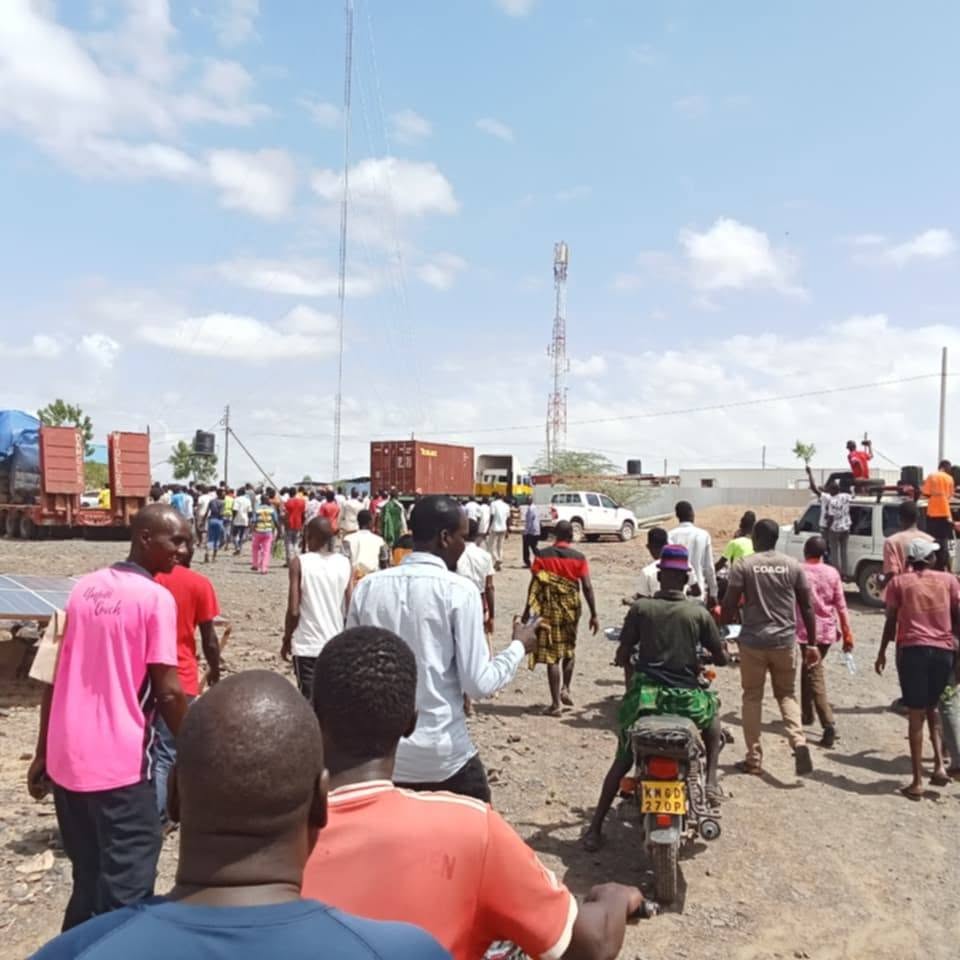
Public anger eventually drew political leadership into the crisis. Turkana Central MP Hon. Emathe Namuar led residents and business owners in a protest at Kenya Power's Lodwar offices, accusing the utility of allowing prolonged outages to devastate the local economy. "Small businesses here depend on power to operate. These outages are not just an inconvenience – they are costing livelihoods," he said.
The demonstration reflected months of accumulated frustration among residents who argued that Turkana was being treated as an afterthought, despite paying for electricity on the same terms as consumers elsewhere in the country.
Kenya Power Responds
Following sustained pressure, Kenya Power engaged local leaders through an initiative that became known as the "Walk for Electric Power," which produced several notable admissions. The utility confirmed the immediate cause of the outages was the failure of one of two generators serving Kanamkemer, with repairs expected within a week – though residents noted this explanation had come only after sustained public pressure, not proactively.
Community leaders also raised concerns over limited local employment, the prolonged engagement of casual workers, and the planned eviction of residents in Power Village, classified as Persons Affected by the Project (PAP). Kenya Power committed to reviewing the employment concerns and pledged transparency and lawful engagement on the evictions.
Most significantly, officials reported that construction of the new Lodwar substation had reached approximately 75 per cent completion, with national grid connection projected by June 2026 – a milestone expected to substantially reduce dependence on the diesel generators that had repeatedly failed the town.
New Generators Offer Temporary Relief
Ahead of the planned grid connection, Kenya Power sought to stabilise supply through additional generation capacity. ENCOMM, the contractor responsible for distribution infrastructure in Turkana, delivered two new generators with a combined capacity of 2.5 MW, expected to improve supply in Kanamkemer and parts of Lodwar after nearly six months of severe instability.
Officials acknowledged, however, that the new machines could only partially resolve the problem, supporting roughly 80 per cent of one power line serving Kanamkemer, while the rest of the municipality continued to rely on ageing generators that had long operated below the region's growing demand. The installation, while a step forward, remained a temporary measure rather than a permanent fix.
Late June 2026: The Crisis Resurfaces
Barely weeks after Kenya Power's assurances of an imminent grid connection, Lodwar was again plunged into darkness. A fresh blackout began on 28 June 2026, with residents reporting hours without power and, once again, no explanation from Kenya Power. One resident, writing publicly, called on the utility to provide advance notice and clear explanations whenever power is switched off, noting that Kenya Power already issues outage notices elsewhere in the country and questioning why Turkana was not afforded the same standard.
Twenty-four hours later, with power still not restored, Jackson Nakusa, Chairperson of the Turkana Professionals Association, voiced his frustration publicly on social media: "Kenya Power, why are you hurting Lodwar residents? Blackout for two long nights, businesses affected, wastage, and heightened night-time insecurity. Fix the power shortage and let the people be. It is inappropriate to allow such a situation to persist for this long."
The outages continued unresolved, with parts of Lodwar Municipality going without power for more than 48 hours and no explanation from the local office. By 2 July 2026 – nearly a week in – Kenya Power had issued no communication, and notably, neither political nor business leadership had publicly raised the matter, unlike the earlier crisis. The prolonged silence carried real consequences: online learning was disrupted, internet-dependent businesses lost income, health facilities faced strain, perishable goods spoiled, and insecurity rose amid non-functioning street lighting.
The recurrence, so soon after Kenya Power's public commitments, has prompted residents and observers to question whether those assurances were substantive – whether the new generators were ever adequate, and why a region with significant solar potential remains so dependent on diesel and an unreliable grid. These remain open questions rather than established facts, but the pattern they describe – public assurance, followed by recurrence, followed by silence – is difficult to ignore, and warrants closer scrutiny from both regulators and elected leaders.
Beyond the Crisis
Even amid the criticism, Kenya Power continued select community investment. The Kenya Power Foundation donated KSh 1 million toward a Form Two classroom at Napetet Mixed Day Secondary School, where students had spent months in borrowed classrooms. The gesture illustrated a recurring tension: even as the company sustained its corporate social responsibility work, many residents remained convinced that its foremost obligation – reliable electricity delivery – was the one it had most consistently failed to meet.
The Bigger Picture
The events in Lodwar reveal more than isolated technical failures. They expose deeper governance challenges within Kenya Power, where allegations of corruption, ageing infrastructure, inadequate investment, weak communication, and delayed accountability have combined to erode public confidence.
For businesses in Turkana, electricity is not a luxury – it is the foundation of commerce, healthcare, education, security, and economic development. The promised grid connection still offers hope for a more reliable future, but the recurrence of unexplained blackouts in late June and early July 2026, arriving within weeks of Kenya Power's own assurances, suggests that hope has not yet translated into consistent delivery. Residents will judge Kenya Power not by promises, but by whether the lights stay on.
For Lodwar, accountability must extend beyond repairing generators. It requires ensuring that years of neglect are not repeated, and that Turkana receives the same standard of service expected elsewhere in Kenya.
Lodwar's crisis is, at its core, a study in what happens when an essential public utility operates with minimal external scrutiny. Acton's warning, written of political rulers, applies with equal force to any institution – corporate or governmental – entrusted with a monopoly over something a population cannot do without. The lesson for Turkana is not that Kenya Power is uniquely corrupt, but that unaccountable power, wherever it sits, tends toward the same outcome unless deliberately checked.


Comments
No approved comments yet. Be the first to join the conversation.