
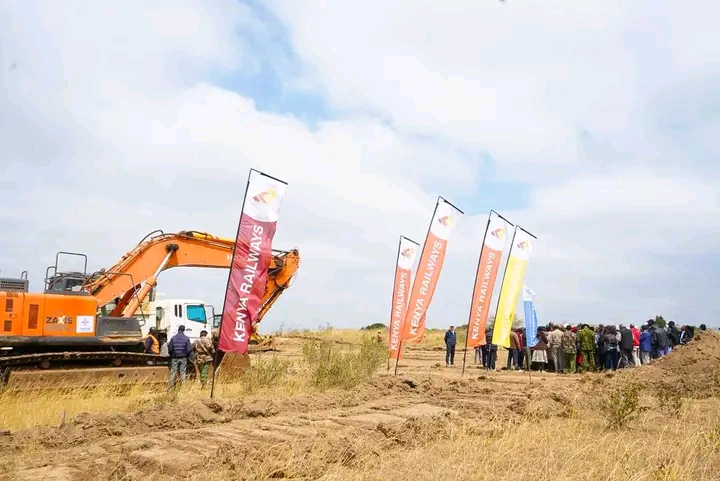
The Kenyan government has officially commenced construction of the long-awaited Standard Gauge Railway extension, a Sh700 billion mega-project that will connect Narok to Kisumu and onward to the Malaba border.
The project marks a major step in expanding Kenya’s railway network and deepening regional trade links with Uganda, Rwanda, Burundi and the Democratic Republic of Congo.
According to details released, the contract for the new railway line has been awarded to two major Chinese construction firms: China Communications Construction Company, CCCC, and China Road and Bridge Corporation, CRBC.
Book a Mid-Article Native AdDesktop: Fluid (728x90) · Mobile: Fluid (300x250)Both companies have an established track record in Kenya, having delivered several of the country’s flagship infrastructure projects in the last decade. Government officials say their selection signals Nairobi’s commitment to delivering the extension to international standards of quality, safety and efficiency.
The Sh700 billion price tag makes this one of the single largest infrastructure investments in Kenya’s history. The railway will be designed to handle both freight and passenger services, with the goal of cutting the cost and time of moving goods from the Port of Mombasa to western Kenya and neighboring landlocked countries.
The new phase will extend the SGR westward from Narok, cutting through the Rift Valley, and linking into Kisumu on the shores of Lake Victoria. From Kisumu, the line will continue to Malaba on the Kenya-Uganda border, where it will connect with Uganda’s planned SGR network.
Transport analysts say the Narok-Kisumu-Malaba corridor is strategic for three reasons.
Book a Mid-Article Native AdDesktop: Fluid (728x90) · Mobile: Fluid (300x250)First, it opens up the agriculturally rich western region to faster, cheaper transport. Counties such as Kericho, Nandi, Kakamega and Bungoma produce tea, sugar, maize and dairy that have long relied on congested road networks.
Second, Kisumu is being positioned as a regional logistics hub. With an operational inland port and improved road links, the lakeside city will now have direct rail access to Mombasa. That is expected to revive cargo movement across Lake Victoria to Uganda and Tanzania.
Third, the link to Malaba completes the missing piece for a seamless regional railway. Once Uganda and other EAC partners complete their sections, goods will be able to move by rail from Mombasa all the way to Kigali and Goma without transshipment.
Government communication framed the project as part of a broader push to lower the cost of doing business and decongest Kenyan roads. Currently, more than 80% of cargo from Mombasa to western Kenya moves by road, contributing to high fuel costs, road accidents, and wear on highways.
Rail, by comparison, can move the same volume of goods with less fuel and fewer trucks. For manufacturers in Kisumu’s industrial area and exporters in Eldoret, that translates to lower logistics costs and more competitive products in regional markets.
While the main contractors are international, officials expect significant local participation. Past SGR phases created thousands of jobs for Kenyans in engineering, surveying, security, catering and materials supply. County governments along the route are already preparing to support feeder roads, land access, and workforce training.
For communities in Narok and Kisumu, the railway is also expected to spur urban growth. Land values near proposed stations are likely to rise, and small businesses that serve construction crews and later, passengers, will have new opportunities.
Environmental safeguards will be critical. The route passes through sensitive ecosystems in the Rift Valley. Government has indicated that environmental impact assessments will guide construction to minimize disruption to wildlife corridors and water sources.
The extension to Malaba is not just a Kenyan project. It is a key pillar of the East African Community’s infrastructure master plan. Trade between Kenya and Uganda alone is worth billions annually, and most of it moves by road through the Northern Corridor.
A functional SGR to Malaba will give Uganda and Rwanda a faster route to the sea. It will also make it easier for Kenyan exporters to reach markets in Central Africa. Officials in Kampala have repeatedly said they are ready to fast-track their own SGR section once Kenya’s line reaches the border.
At the continental level, the project feeds into the African Continental Free Trade Area agenda, which seeks to boost intra-Africa trade by improving transport and customs systems.
A project of this magnitude will face scrutiny on cost, debt, and implementation timelines. The Sh700 billion investment will require careful fiscal management. Government has emphasized transparency in procurement and value for money as construction gets underway.
Land acquisition and resettlement along the route will also need to be handled sensitively. Experience from earlier SGR phases shows that early engagement with communities helps avoid delays.
Technical challenges are equally real. Building across the Rift Valley escarpment and around Lake Victoria will require major bridges and earthworks. But with CCCC and CRBC at the helm, both firms that delivered the Mombasa-Nairobi SGR, there is confidence the engineering can be done.
For now, the start of construction sends a strong signal: Kenya is doubling down on rail as the backbone of its transport future. If completed on schedule, the Narok-Kisumu-Malaba line will reshape how people and goods move across western Kenya and beyond.
For residents of Yala, Kisumu, Kakamega and other towns along the corridor, the promise is simple: faster travel, cheaper goods, and new economic opportunities tied to a modern railway.

Comments
No approved comments yet. Be the first to join the conversation.