
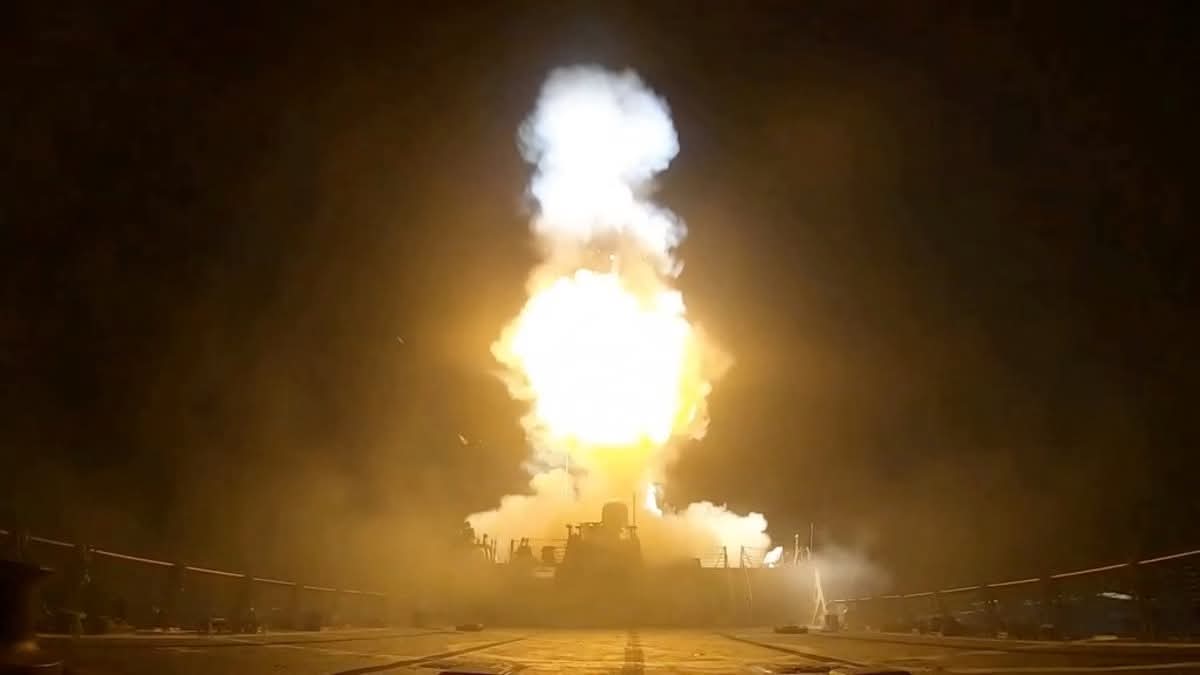
Tensions between the United States and Iran have surged to their highest point in months after a fresh exchange of missile and drone strikes. Iran launched attacks on U.S. military sites across five Gulf nations and declared the Strait of Hormuz closed to all shipping, just hours after Washington carried out a major overnight bombing campaign against Iranian military facilities.
The escalation threatens to unravel a fragile ceasefire that had been in place since late February and raises immediate concerns about oil supplies, commercial shipping, and stability across the Middle East.
According to U.S. Central Command, American forces hit around 140 Iranian military targets on Saturday in what officials described as the third round of strikes against Iran in the past week. The targets included missile sites, drone storage depots, naval capabilities, ammunition facilities, and coastal surveillance positions around the Strait of Hormuz.
Book a Mid-Article Native AdDesktop: Fluid (728x90) · Mobile: Fluid (300x250)The strikes were ordered by President Donald Trump after Iranian forces "blatantly attacked" the Cyprus-flagged container ship M/V GFS Galaxy in the Strait of Hormuz. U.S. officials said the vessel’s engine room was damaged, a fire broke out on board, and one civilian crew member is missing.
U.S. Defense Secretary Pete Hegseth posted on X: “Iran made a poor choice. Now they pay.” President Trump vowed Tehran would face a “heavy cost” for the attack on shipping.
The U.S. military said the strikes were intended to "degrade Iran’s ability to attack civilian mariners and commercial vessels freely transiting the strait". This was the third major U.S. operation against Iran in a week.
Iran responded within hours. The Islamic Revolutionary Guard Corps said it had launched missile and drone attacks on U.S. facilities in Jordan, Bahrain, Oman, Qatar, and the United Arab Emirates. 2fe0ab5c
Book a Mid-Article Native AdDesktop: Fluid (728x90) · Mobile: Fluid (300x250)Specifically, Iran claimed it destroyed a command and control center and drone hangars at a U.S. ally base in Jordan, targeted a U.S. radar site in Kuwait, hit aircraft support and refueling platforms in Oman, and struck a jet maintenance center and command facility in Qatar. The IRGC also said it carried out drone strikes on the U.S. Fifth Fleet headquarters in Bahrain.
Gulf governments confirmed the attacks. The UAE Ministry of Defense said air defenses were "actively engaging" incoming missiles and drones, and residents reported hearing explosions as interceptors were fired. Qatar said three people, including a child, were injured by falling shrapnel. Bahrain sounded air raid sirens and Kuwait said its forces intercepted missiles and drones in its airspace.
Alongside the strikes, Iran announced it was closing the Strait of Hormuz "until further notice". The IRGC said the waterway would remain closed "until the end of U.S. interference in this region", and warned that "no vessel will be allowed to pass". Iranian authorities said any ship attempting to transit would be targeted.
Iran justified the move by accusing a Cyprus-linked vessel of taking an "unapproved route" through the strait. The Guards said they fired warning shots and disabled a second vessel.
The Strait of Hormuz is one of the world’s most critical chokepoints for energy. Before the conflict, about one-fifth of the world’s oil and LNG shipments passed through it. A closure immediately raises fears of a spike in global oil prices and disruptions to trade between Asia, Europe, and the Gulf.
U.S. Central Command disputed Iran’s claim of a full closure, saying commercial vessels continue to transit the waterway. The U.S. military said it had helped facilitate the transit of more than 800 commercial vessels and 380 million barrels of crude oil since early May.
Still, Iran said the number of vessels transiting under its supervision had dropped and that permission was now being granted only to ships using routes designated by Tehran.
Iranian state media reported that U.S. strikes killed 14 people and injured 78 across five Iranian provinces on July 8 and 9. One strike reportedly hit a rail bridge used for trade with Russia and China. Explosions were also heard in Bushehr province, home to a Russian-built nuclear power plant, and in the port city of Bandar Abbas.
On the Gulf side, Qatar confirmed injuries from shrapnel, and Bahrain reported a minor injury to an 11-year-old girl and damage to vehicles and homes. Jordan said its air defenses intercepted 20 missiles and that falling shrapnel caused no casualties.
The current flare-up comes after weeks of fragile calm. President Trump declared the end of an interim ceasefire meant to halt fighting that began with U.S.-Israeli strikes on February 28. The deal had been contingent on safe passage through the Strait of Hormuz.
Despite Trump’s declaration, both sides had left the door open to negotiations. Iranian negotiators had reportedly sought to continue talks, but the Revolutionary Guard’s repeated attacks undermined those efforts, according to U.S. officials.
Now, with strikes hitting both Iranian territory and U.S. bases across the Gulf, analysts say the region is closer to all-out war than at any point since the ceasefire began.
The attacks mark one of the largest exchanges of hostilities since April. Iran’s Foreign Ministry condemned the U.S. "aggressive attacks" as a "grave war crime". Most Gulf states condemned Iran for targeting Kuwait, Bahrain, and others.
Oil markets reacted quickly. Prices had spiked on fears of disrupted shipping, but eased back on Thursday as traders assessed whether the escalation would be temporary.
The IRGC warned that any further U.S. intervention would draw a "crushing response", and said its forces remain prepared to deliver a "crushing and decisive" reply.
The situation remains fluid. The U.S. says its goal is to keep the Strait of Hormuz open, while Iran says it will keep the waterway closed until Washington stops interfering.
Military officials on both sides have signaled they are prepared for more action. U.S. Central Command said the latest strikes were carried out "at the direction of President Trump". Iran said "more U.S. attacks will be met with even more severe responses".
For now, Gulf states are on high alert. Air defense systems remain active, and civilians in Qatar, Bahrain, and the UAE have been urged to follow safety instructions.
The exchange has also cast doubt on broader diplomatic efforts. The war began with joint U.S.-Israeli strikes in February, and subsequent attempts to negotiate a lasting agreement have stalled. Trump himself said Iran had "taken too long to negotiate a deal" and "now they will have to pay the price".
As commercial shipping, energy markets, and millions of people across the Gulf watch closely, the coming days will determine whether this escalation spirals further or whether channels for de-escalation can be reopened.


Comments
No approved comments yet. Be the first to join the conversation.