
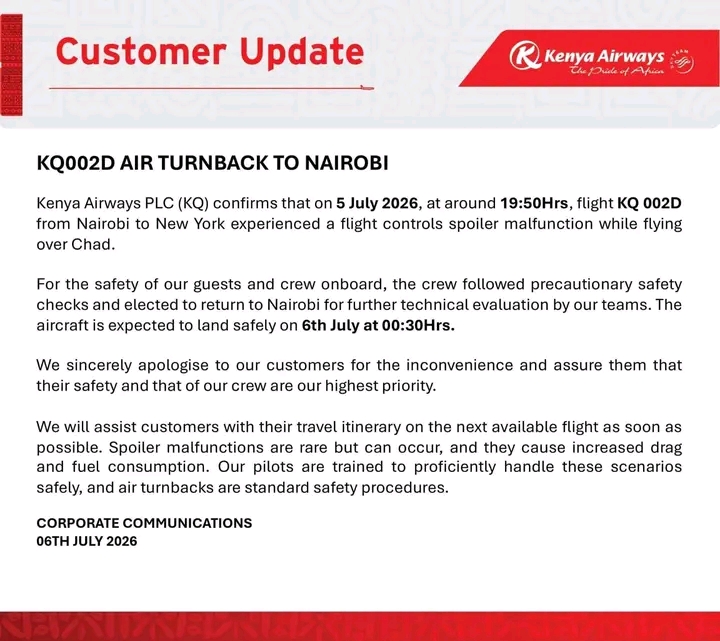
NAIROBI, 6 July 2026, A Kenya Airways long-haul flight bound for New York was forced to reverse course and return to Jomo Kenyatta International Airport on Sunday night after the crew detected a technical issue with the aircraft’s flight control system while over Central Africa.
The national carrier confirmed in a statement on Monday that flight KQ 002D, which departed Nairobi on the evening of 5 July 2026, experienced a malfunction affecting the spoilers at approximately 7:50 PM local time while cruising over Chad.
In line with standard operating procedures, the flight deck team carried out precautionary checks and made the decision to turn back to Nairobi for a full technical inspection on the ground. The airline said the aircraft touched down safely in the early hours of Monday, 6 July 2026, at around 12:30 AM.
Book a Mid-Article Native AdDesktop: Fluid (728x90) · Mobile: Fluid (300x250)Kenya Airways flight KQ 002D operates the carrier’s direct service from Nairobi to New York’s John F. Kennedy International Airport. It is one of the airline’s flagship routes and typically carries hundreds of passengers on the 14-hour journey across Africa, the Atlantic, and into the United States.
According to the statement issued by Corporate Communications, the problem was linked to the aircraft’s spoiler system. Spoilers are panels on the wings that help control lift, drag and descent. While failures are uncommon, they can increase aerodynamic drag and fuel burn, and may require adjustments to how the plane is handled in flight.
“On 5 July 2026, at around 19:50Hrs, flight KQ 002D from Nairobi to New York experienced a flight controls spoiler malfunction while flying over Chad,” the airline said.
Faced with the anomaly, the pilots opted not to continue across the Atlantic. Instead, they prioritized a return to base where engineers and maintenance teams could assess the aircraft thoroughly.
Book a Mid-Article Native AdDesktop: Fluid (728x90) · Mobile: Fluid (300x250)“For the safety of our guests and crew onboard, the crew followed precautionary safety checks and elected to return to Nairobi for further technical evaluation by our teams,” Kenya Airways noted.
The airline stressed that the decision to turn back was purely precautionary and that at no point were passengers or crew in immediate danger.
The unexpected return meant a significant disruption for travelers on board who were en route to the U.S. Kenya Airways said it is working to accommodate all affected customers on the next available flight to New York.
“We sincerely apologise to our customers for the inconvenience and assure them that their safety and that of our crew are our highest priority,” the carrier stated. “We will assist customers with their travel itinerary on the next available flight as soon as possible.”
Passengers were provided with updates at the airport and given support including refreshments and accommodation where necessary while waiting for rebooking. The airline has not yet announced the exact departure time of the replacement service, but said rebooking efforts began immediately after landing.
In aviation, spoilers play a critical role in flight performance. They are used to reduce lift, increase drag, and help the aircraft descend or slow down, especially during landing. A malfunction does not typically make an aircraft unflyable, but it can limit operational options and increase fuel consumption, which is a key consideration on ultra-long-haul routes like Nairobi-New York.
Kenya Airways explained that such faults, while rare, are part of the technical issues airlines are trained to manage.
“Spoiler malfunctions are rare but can occur, and they cause increased drag and fuel consumption. Our pilots are trained to proficiently handle these scenarios safely, and air turnbacks are standard safety procedures,” the statement read.
Aviation safety experts note that turning back to the departure airport is a common and conservative decision when a technical issue arises early in a long flight. It allows the airline to resolve the problem without the added complexity of a diversion to an unfamiliar station mid-route.
The incident underscores the emphasis commercial airlines place on proactive safety management. International regulations require flight crews to assess any technical alert against a checklist of procedures. If a system affecting performance or redundancy is impacted, crews are often advised to land at the nearest suitable airport — or in this case, return to base where full support is available.
Kenya Airways, which brands itself as “The Pride of Africa,” operates a modern fleet and has in recent years expanded its intercontinental network. The Nairobi-New York route, launched in 2018, is a key part of that strategy and is closely watched as a symbol of the airline’s global ambitions.
The carrier has not indicated how long the affected aircraft will remain out of service. Engineering teams were expected to conduct detailed diagnostics on Monday morning to determine the root cause of the spoiler fault and to carry out any necessary repairs or component replacements before the plane is cleared to fly again.
While the turnback caused delays for passengers on KQ 002D, the airline said other scheduled flights were not affected. The Nairobi-JFK route typically operates daily, which gives the airline flexibility to move passengers onto subsequent services.
For many travelers, the disruption meant missed connections in New York and adjustments to onward travel plans. Kenya Airways’ customer service teams were tasked with reissuing tickets and coordinating with partner airlines to minimize further delays.
The airline’s apology acknowledged the frustration that comes with unexpected changes. “We sincerely apologise to our customers for the inconvenience,” the statement reiterated.
The Nairobi-New York flight is among the longest non-stop routes operated by any African carrier, covering more than 11,800 kilometers. Because of the distance, fuel planning and aircraft performance are critical. Any issue that could affect fuel efficiency, such as a spoiler problem, is taken seriously by dispatch and flight crews.
Kenya Airways has built a reputation for adhering to international safety standards and undergoes regular audits by the International Air Transport Association and the Kenya Civil Aviation Authority. The airline has also invested in pilot training simulators that include scenarios for system malfunctions, ensuring crews can respond calmly and by the book.
Industry observers say the handling of Sunday night’s incident reflects that training. There were no reports of panic on board, and the landing in Nairobi was described by the airline as normal.
As of Monday morning, Kenya Airways had not released further technical details about the specific aircraft involved or the timeline for its return to service. The airline said updates would be provided to booked passengers directly.
For now, the focus remains on getting travelers to their destination with minimal further disruption. The carrier’s statement closed by reaffirming its commitment to safety above schedule.
“Air turnbacks are standard safety procedures,” the airline concluded, emphasizing that such decisions, while inconvenient, are a key part of maintaining high safety margins in commercial aviation.



Comments
No approved comments yet. Be the first to join the conversation.