
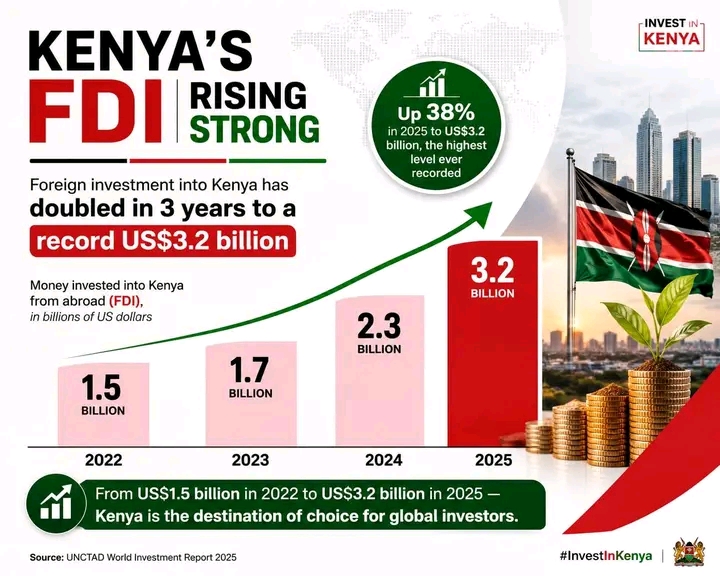
Kenya’s push to position itself as East Africa’s investment hub is gaining traction on the world stage, with new United Nations data showing the country attracted a record level of foreign capital in 2025.
According to the United Nations Conference on Trade and Development’s World Investment Report 2026, foreign direct investment into Kenya more than doubled over the past three years. Annual FDI rose from $1.5 billion in 2022 to $3.2 billion in 2025, marking the largest single-year inflow the country has ever recorded.
The report also notes that Kenya’s cumulative stock of foreign investment has now crossed the $12 billion mark. That figure represents the total value of foreign-owned assets and businesses operating in the country, and signals that investors are not just arriving, but staying and expanding.
Book a Mid-Article Native AdDesktop: Fluid (728x90) · Mobile: Fluid (300x250)Government officials have described the numbers as proof that Kenya’s economic strategy is resonating with global markets.
The UNCTAD report points to four sectors leading Kenya’s investment momentum.
First is clean energy, particularly geothermal development. Kenya has spent the last decade expanding its geothermal capacity in the Rift Valley, and that work is now drawing significant private capital. Investors see the country’s renewable energy base as both a cost advantage for industry and a hedge against volatile fossil fuel prices.
Second is digital infrastructure. From data centers and fiber networks to fintech platforms and business process outsourcing, Kenya’s tech ecosystem continues to attract venture funding and strategic partnerships. Nairobi’s reputation as “Silicon Savannah” has helped position the country as a gateway for companies looking to scale across Africa.
Book a Mid-Article Native AdDesktop: Fluid (728x90) · Mobile: Fluid (300x250)Third, financial services. Banks, insurance firms, and investment funds have been expanding products aimed at retail customers and small businesses. The growth of mobile money and digital lending has made Kenya one of the most financially included economies on the continent, which in turn makes it more attractive for foreign financial institutions.
Fourth is manufacturing. New plants in agro-processing, textiles, pharmaceuticals, and construction materials have been set up to serve both the local market and regional export demand under the African Continental Free Trade Area.
Together, these sectors account for the bulk of new projects announced and funded in the last 24 months.
Analysts say the FDI jump is not happening in isolation. It is supported by several domestic conditions that have improved investor sentiment.
The Kenyan shilling has stabilized after a period of volatility, reducing currency risk for companies repatriating profits. The Nairobi Securities Exchange has also seen a rally, with increased trading volumes and new listings that give foreign portfolio investors more options.
On the policy side, the government’s privatization agenda has opened space for private capital in state-owned enterprises. The plan is designed to improve efficiency in sectors like transport, energy, and housing, while giving investors access to large-scale projects that were previously closed.
Other reforms highlighted in recent months include streamlined business licensing, improvements in port operations at Mombasa, and efforts to reduce the time and cost of starting and running a business.
“Investors look for three things: policy predictability, market size, and infrastructure,” said one Nairobi-based economist who follows FDI trends. “Kenya is ticking more of those boxes now than it did a few years ago.”
Foreign investment does not automatically translate into jobs or lower prices, but economists say the direction of travel is positive.
When a geothermal plant is funded, it creates construction jobs and later provides cheaper, more reliable power to factories. When a manufacturer sets up, it sources inputs locally and hires workers. When a fintech raises capital, it builds products that help small traders access credit.
The $12 billion stock figure is particularly important because it reflects long-term commitment. These are not short-term portfolio flows that can leave quickly. They are factories, data centers, power plants, and financial institutions that are anchored in the economy.
The timing also matters. Many economies are still navigating higher interest rates and cautious global investors. That Kenya was able to double inflows in that environment suggests it is being viewed as a relative safe haven in the region.
Kenya has long competed with Ethiopia, Tanzania, Uganda, and Rwanda for investment in East Africa. What sets it apart, according to UNCTAD’s methodology, is the combination of a large consumer market, relatively deep capital markets, and an established services sector.
The country also benefits from its role as a logistics and aviation hub. Jomo Kenyatta International Airport and the port of Mombasa connect landlocked neighbors to global trade routes, making Kenya a natural base for companies serving the wider region.
The AfCFTA agreement adds another layer. With 54 countries and more than 1.3 billion people, the continental market gives manufacturers in Kenya a much bigger addressable audience than the domestic market alone.
Despite the positive headlines, experts caution that sustaining this momentum will require continued work.
Infrastructure gaps still exist outside major cities. Energy costs, while falling with more geothermal, remain a concern for energy-intensive industries. And while reforms are underway, investors still cite bureaucracy and inconsistent policy implementation as friction points.
There is also the need to ensure that investment leads to skills transfer and local value addition. The goal is not just to attract capital, but to build industries that can compete globally without permanent subsidies.
The tone from both the UNCTAD report and local officials is optimistic. The phrase used in the announcement was that “investor confidence in Kenya has never been higher,” and that “the best is yet to come.”
If the current trajectory holds, Kenya could see FDI remain above $3 billion annually in the near term. That would put it in a stronger position to fund its development agenda without over-relying on debt.
The next test will be execution. Can the projects that have been announced move to construction quickly? Can the privatization program deliver better services? Can the digital and energy sectors continue to scale?
For now, the data offers a clear signal. The world is paying attention to what Kenya is building, and more capital is choosing to land here.
With a young population, a growing middle class, and strategic location, Kenya’s case for investment is becoming harder to ignore. The 2025 figures may end up being remembered not as a peak, but as the start of a new baseline.
The UNCTAD World Investment Report is published annually and tracks global FDI flows, cross-border mergers, and greenfield projects. It is considered one of the key barometers for how international investors view individual countries.



Comments
No approved comments yet. Be the first to join the conversation.