
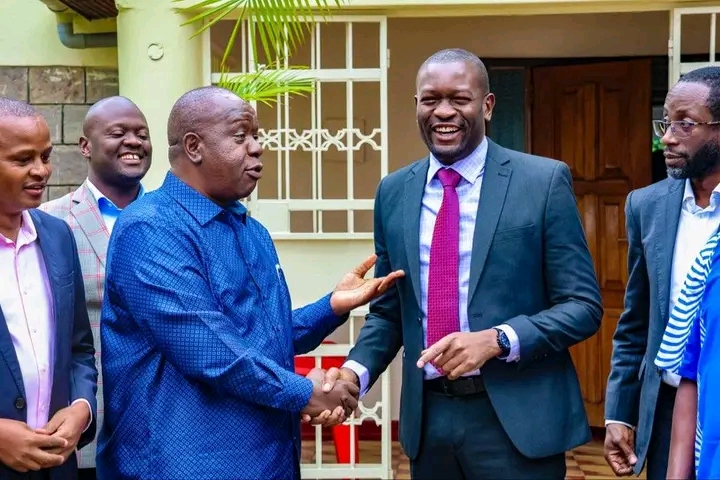
A high-level political engagement took place in Karen on Wednesday morning as senior officials from the civic movement Linda Mwananchi met with former Cabinet Secretary and presidential aspirant Fred Matiang'i. The meeting, held at a private residence in the upscale Nairobi suburb, signals growing consultations between civil society-aligned groups and leading contenders ahead of the next general election.
Photographs from the session show Matiang'i welcoming the delegation with handshakes outside before moving into closed-door discussions inside the home. The delegation, dressed in formal business attire, was later seen seated with the former Interior Cabinet Secretary in what appeared to be a candid exchange around governance, public accountability, and the direction of the country.
According to details shared on social media, the Linda Mwananchi team traveled to Karen early in the day for the engagement. The pictures captured both outdoor and indoor moments, suggesting the talks covered a range of issues and lasted for a considerable period. In one image, Matiang'i is seen greeting members of the delegation at the gate, a gesture that set the tone for what looked like a cordial reception. Inside, the group sat in a living room setting, engaging in discussion without the usual trappings of a large political rally. The informal yet structured environment points to a strategy meeting rather than a public endorsement event.
Book a Mid-Article Native AdDesktop: Fluid (728x90) · Mobile: Fluid (300x250)The Linda Mwananchi movement has positioned itself as a voice for ordinary citizens, pushing for transparency, service delivery, and protection of public interests. By meeting directly with a declared presidential candidate, the group appears to be testing policy positions and seeking commitments on key governance reforms.
Fred Matiang'i served as Cabinet Secretary for Interior and Coordination of National Government during the previous administration, and previously held dockets in Education and Information, Communication and Technology. He is widely known for his no-nonsense administrative style, particularly during his tenure in the education sector where he oversaw major reforms to curb exam cheating and streamline operations. Since leaving government, Matiang'i has been mentioned frequently as a potential candidate for the presidency. While he has not made a formal declaration through a major political party, he has maintained a visible public presence and has been engaging with various professional groups, community leaders, and civic organizations across the country.
His background as a technocrat and his record in security and education make him a notable figure in conversations about leadership and institutional reform. Analysts say meetings like the one in Karen are part of a broader effort by aspirants to build alliances beyond traditional political structures and to tap into grassroots movements that claim to represent citizen interests.
Linda Mwananchi, loosely translated as "Protect the Citizen," has emerged in recent years as one of several civic formations advocating for accountability from elected leaders. The group has been active in public forums, community barazas, and online platforms, where it raises concerns about corruption, cost of living, and implementation of public programs. The movement describes its mission as defending the rights of ordinary Kenyans and ensuring that government policies translate into tangible benefits at the household level. Its leaders have often criticized both the executive and legislature for what they call a disconnect with the needs of voters, particularly in rural and peri-urban areas.
Book a Mid-Article Native AdDesktop: Fluid (728x90) · Mobile: Fluid (300x250)By sitting down with Matiang'i, the group is signaling a willingness to engage directly with those seeking the country’s top office. Such engagements are increasingly common as 2027 approaches, with civil society groups positioning themselves as influential voices who can shape voter opinion by pressing candidates on policy.
Karen has long been a venue for discreet political meetings in Kenya. The leafy suburb, home to many senior politicians and diplomats, offers privacy away from the media glare of central Nairobi. Choosing to meet there rather than at a party headquarters or public hall suggests both sides wanted a frank, off-the-record conversation. For a presidential hopeful, hosting civic leaders at a private residence also projects an image of accessibility and consultation. It frames the candidate as someone willing to listen to non-partisan voices before crafting policy. For the civic group, it provides an opportunity to present a memorandum of concerns without the pressure of a public crowd.
While no official communique has been released, the context of the meeting offers clues about the agenda. Linda Mwananchi has consistently pushed for three broad areas: economic relief for households, strengthening of public institutions, and respect for constitutional rights. On the economy, the group has been vocal about the rising cost of food, fuel, and school fees. It is likely they pressed Matiang'i on what concrete measures he would take to lower the cost of living within the first 100 days of office.
On governance, the movement has called for a leaner government, merit-based appointments, and stronger anti-corruption mechanisms. Given Matiang'i’s reputation for firm implementation while in government, the delegation may have sought assurances that he would apply the same discipline at the presidential level. On citizen rights, Linda Mwananchi has previously condemned excessive use of force during public protests and demanded greater police accountability. With Matiang'i’s background in the Interior docket, this was almost certainly part of the conversation.
The meeting comes at a time when Kenya’s political landscape is beginning to take shape for the next election cycle. Several prominent figures have already started touring the country, while others are holding behind-the-scenes talks with interest groups. For Matiang'i, engaging with Linda Mwananchi helps broaden his base beyond party politics. Civic groups often have networks in communities that are hard for traditional politicians to reach, and an endorsement, or even a neutral statement after such a meeting, can carry weight.
For Linda Mwananchi, the meeting is a way to ensure that whoever wins the presidency cannot claim ignorance of citizen priorities. By meeting candidates early, the group can later hold them to promises made during these consultations. Political observers note that Kenyan voters have become more issue-driven in recent elections. Movements that focus on service delivery rather than ethnic mobilization are gaining traction, especially among young voters and urban professionals. That makes alliances between aspirants and civic groups strategically important.
The photos from the meeting quickly circulated online and drew hundreds of reactions within hours. Commenters debated whether such engagements lead to real change or are simply political optics. Others praised the move as an example of direct democracy, where citizens’ representatives can question those seeking power. The tone of the online discussion reflects a broader public mood: cautious optimism mixed with demand for accountability. Many Kenyans say they are tired of campaign promises that are forgotten after elections, and they are watching closely to see if groups like Linda Mwananchi can extract commitments and follow up on them.
It remains unclear whether this was a one-off courtesy call or the beginning of a structured partnership. However, the fact that it happened, and that both sides allowed images to be shared, indicates they see value in the public knowing about the engagement. For Matiang'i, the next steps will likely involve more of these consultations with professional bodies, faith groups, and community organizations as he clarifies his platform. For Linda Mwananchi, the challenge will be to maintain independence while engaging with political actors, and to communicate back to its members what was discussed and what was promised.
Kenya’s democracy has matured to a point where such meetings are no longer unusual. What will matter is what comes after: whether the ideas exchanged in Karen translate into policy proposals, and whether citizens feel their concerns are being reflected in the national conversation. As the election season draws closer, expect more of these quiet but significant meetings. They may not make headlines the way rallies do, but they often shape the platforms and alliances that define campaigns. The Karen meeting between Linda Mwananchi and Fred Matiang'i is one more sign that 2027 politics will be fought not just in stadiums, but also around tables where policy and principle are on the agenda.


Comments
No approved comments yet. Be the first to join the conversation.