

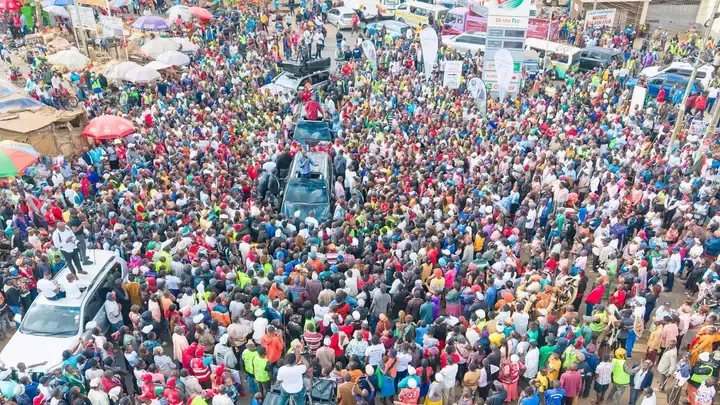
Tension gripped Kisumu’s central business district on Sunday morning after police officers discharged teargas to break up a group of suspected hired agitators who attempted to force their way into St. Stephen’s Cathedral. The disruption occurred while senior opposition figures were inside for a church service, turning what was meant to be a peaceful worship gathering into a scene of confusion and heightened security.
Officers moved quickly to contain the crowd that had gathered at the cathedral gates. The group, described as “suspected goons,” was reportedly trying to storm the premises where Nairobi Senator Edwin Sifuna and Siaya Governor James Orengo were attending a service organized by Linda Mwananchi, a civic movement associated with grassroots mobilization.
Worshippers and passersby scattered as the gas filled the air around the cathedral, which sits in a busy part of Kisumu City. There were no immediate reports of injuries, but the abrupt action disrupted both the service and normal activities in the area for nearly an hour.
Book a Mid-Article Native AdDesktop: Fluid (728x90) · Mobile: Fluid (300x250)Police have not yet issued a formal statement detailing how many people were involved or whether any arrests were made. However, officers remained stationed around the cathedral long after the teargas was fired, a move authorities said was meant to secure the venue and the dignitaries inside.
The service was attended by key figures from the Linda Mwananchi movement, a platform that has become increasingly vocal on governance, cost-of-living issues, and civic rights.
Senator Edwin Sifuna, who serves as the Secretary General of the ODM party, has been one of the most visible faces of the movement. Known for his blunt speeches and regular town-hall engagements, Sifuna has positioned Linda Mwananchi as a voice for ordinary citizens.
Joining him was Siaya Governor James Orengo, a veteran lawyer and longtime opposition figure. Orengo’s presence added political weight to the gathering, given his influence in Nyanza politics and his role in shaping opposition strategy in recent years.
Book a Mid-Article Native AdDesktop: Fluid (728x90) · Mobile: Fluid (300x250)Church officials had described the service as a thanksgiving and prayer meeting for the community. The decision to host prominent political leaders, however, drew a large turnout, both of supporters and of curious onlookers.
St. Stephen’s Cathedral is one of Kisumu’s oldest Anglican churches and has historically hosted political leaders during key moments. Because of its central location and symbolic value, it often becomes a venue where politics and faith intersect.
The attempt to access the church comes amid rising political activity across the country. Linda Mwananchi has in recent months organized a series of public forums and church-based meetings to discuss economic hardship, devolution, and citizen participation. These gatherings typically attract large crowds and, at times, counter-groups.
Security analysts note that places of worship have increasingly become venues for political messaging, which in turn has raised concerns about safety and neutrality. Sunday’s incident in Kisumu reflects that growing tension.
The use of teargas to disperse crowds is not new in Kenya, especially during politically charged events. On Sunday, officers said their priority was to prevent a breach of the cathedral and to protect those attending the service.
The quick deployment appears to have stopped the group from entering. By mid-morning, calm had returned around the cathedral, though a heavy police presence remained.
“Church should be a safe space,” one commenter wrote. “Whatever differences we have, let’s not bring chaos to the house of God.”
Another noted the broader pattern: “We keep seeing this. Every time leaders meet, there are people trying to cause trouble.”
Linda Mwananchi, loosely translated as “Protect the Citizen,” has positioned itself as a grassroots watchdog. Since its formation, the movement has held rallies, door-to-door campaigns, and church forums to engage voters directly.
Senator Sifuna has often said the group’s goal is to “return power to the people” by creating spaces where citizens can question leaders without fear. Governor Orengo has similarly used church platforms to speak on constitutionalism and accountability.
Critics, however, argue that such meetings blur the line between civic education and partisan politics. Supporters counter that churches are among the few remaining spaces where communities can gather freely to discuss national issues.
The disruption at St. Stephen’s raises several questions about public order, freedom of assembly, and the role of security agencies during political events.
First, it highlights the challenge of securing public gatherings without infringing on worship. Church leaders across Kenya have repeatedly called for political activities to be kept separate from religious services. Yet the reality on the ground is that politicians continue to use Sunday services as platforms to reach constituents.
Second, the incident points to ongoing concerns about political hired groups. The term “goons” is frequently used in Kenyan politics to describe individuals allegedly paid to intimidate opponents or disrupt events. Whether that was the case in Kisumu remains unconfirmed, as police have not named any suspects.
Third, it underscores the volatile nature of opposition politics in 2026. With midterm political realignments underway, any gathering of high-profile leaders is likely to attract attention both supportive and hostile.
As of Sunday afternoon, the service at St. Stephen’s had concluded without further incident. Senator Sifuna and Governor Orengo were escorted out under police guard.
It is unclear whether the police will launch a formal investigation into the attempted breach. Civil society groups in Kisumu have already called for calm and urged authorities to protect the right to worship.
For residents of Kisumu, the events were a reminder of how quickly a peaceful day can change. For political observers, it was another sign that the intersection of faith, politics, and public security will remain a contested space in the months ahead.
The cathedral, which reopened to parishioners later in the day, stood as it often does: at the center of community life, and now, at the center of a national conversation about safety, politics, and respect for sacred spaces.

Comments
No approved comments yet. Be the first to join the conversation.