
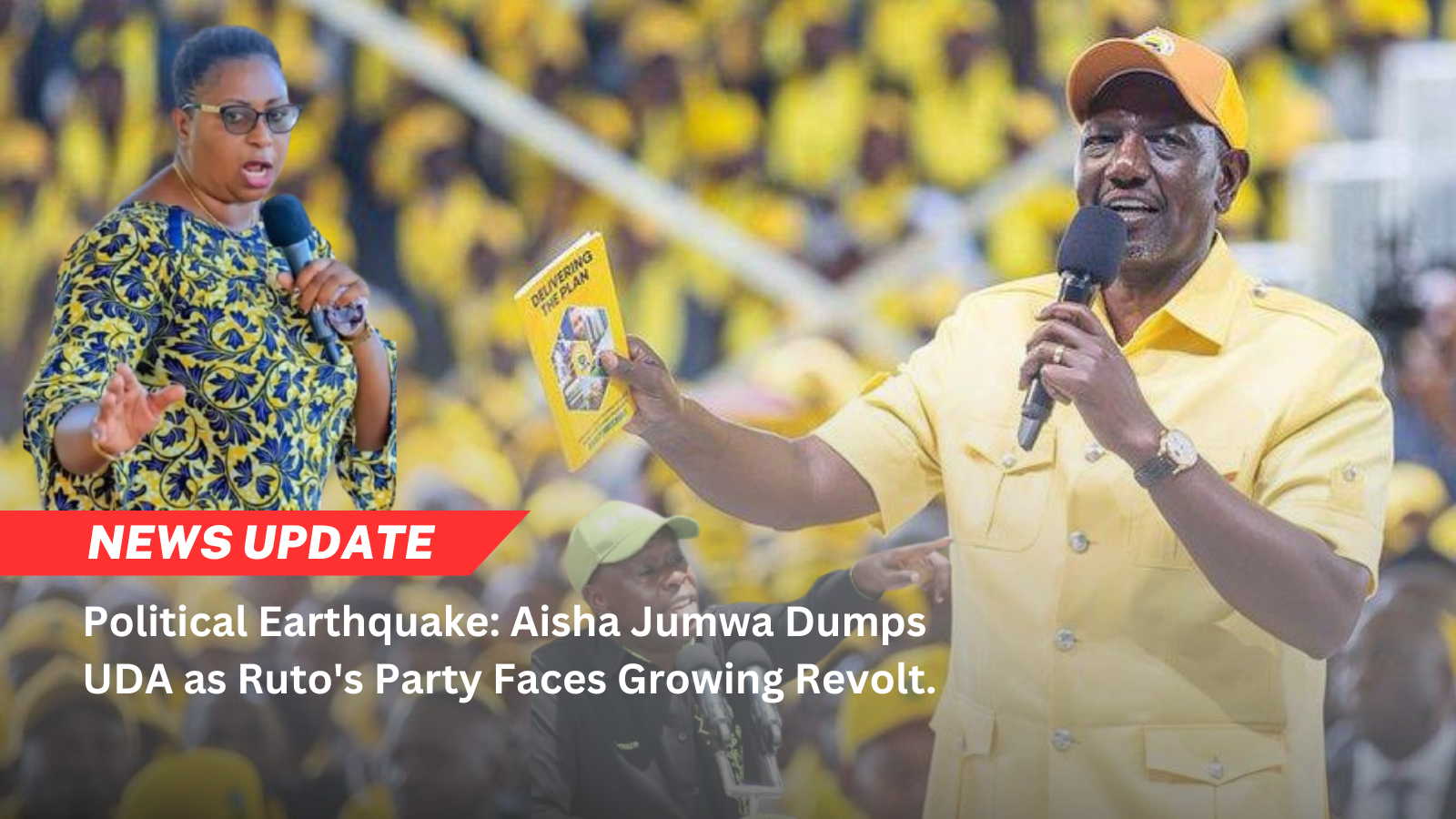
Former Public Service Cabinet Secretary Aisha Jumwa has officially resigned from the ruling United Democratic Alliance (UDA), delivering another major political blow to President William Ruto's party as political realignments gather momentum ahead of the 2027 General Election.
Jumwa announced her resignation in a strongly worded statement, saying the decision followed deep reflection, prayer, and consultations with the people of Kilifi. She indicated that she could no longer remain in a political party where, according to her, her democratic ambitions had been frustrated.
The former Cabinet Secretary cited humiliation and growing frustration over her quest to contest for the Kilifi Governor seat in the 2027 elections, arguing that the people should be allowed to freely choose their leaders without political interference.
Book a Mid-Article Native AdDesktop: Fluid (728x90) · Mobile: Fluid (300x250)"Today, I have made one of the most difficult decisions of my political journey. After deep reflection, prayer, and listening to the voices of the people of Kilifi, I have officially resigned from the United Democratic Alliance (UDA)," Jumwa said.
She maintained that her decision was not driven by anger but by her conscience and commitment to defending democracy.
"This decision is guided not by anger, but by my conscience and my unwavering commitment to defend the democratic right of the people to choose their leaders freely. My loyalty has always been, and will always remain, with the people of Kilifi."
Jumwa further assured her supporters that she remains committed to building a county founded on justice, accountability, opportunity and servant leadership.
Book a Mid-Article Native AdDesktop: Fluid (728x90) · Mobile: Fluid (300x250)She also revealed that consultations are underway to unveil a new political vehicle that will spearhead her 2027 gubernatorial campaign.
"In the coming days, we shall unveil the political vehicle that will carry our collective dream for a better Kilifi. Together, we will write the next chapter of Kilifi's future."
Her resignation adds to a growing list of high-profile politicians abandoning the ruling party as Kenya's political landscape undergoes significant changes ahead of the next General Election.
Wave of Defections Hits UDA.
Jumwa joins several influential leaders who have either resigned from UDA or openly declared their intention to leave the party.
Among the notable political figures who have shifted allegiance are Murang'a Governor Irungu Kang'ata and Nyandarua Governor Kiarie Badilisha, who have aligned themselves with former Deputy President Rigathi Gachagua's Democracy for the Citizens Party (DCP).
Former Cabinet Secretary Mithika Linturi has also publicly exited UDA, while former Nairobi Governor Mike Sonko continues to rally leaders under the National Economic Development Party (NEDP).
Within Parliament, a number of legislators from the Mount Kenya region—including outspoken government critics such as James Gakuya, Gathoni wa Muchomba, and Ndindi Nyoro—have either formally left UDA or signaled plans to chart a different political path before the 2027 elections.
The growing exodus has raised fresh questions about UDA's ability to maintain its political dominance as new alliances continue to emerge across the country.
Opinion Polls Show Changing Political Fortunes.
Recent national opinion polls suggest that Kenya's political competition has become increasingly fragmented, with established parties facing pressure from emerging political formations.
According to TIFA Research's July 2026 national survey, the Orange Democratic Movement (ODM) has overtaken UDA as the country's most popular political party, attracting 20 percent support compared to 17 percent for UDA.
A separate survey conducted by Infotrak Research & Consulting presents a much tighter race, placing UDA at 22 percent and ODM at 21 percent, indicating that the contest remains highly competitive.
The polls also identify Gachagua's DCP as an emerging political force with 12 percent national support, while Jubilee Party stands at 10 percent and Wiper Democratic Movement follows with 6 percent.
Perhaps most significant is the large bloc of undecided voters. Between 22 percent and 28 percent of Kenyans surveyed said they do not currently identify with any political party, making them a potentially decisive voting bloc in the run-up to the 2027 elections.
UDA-ODM Arrangement Faces Resistance.
The surveys further reveal mixed public reactions to the political cooperation between President Ruto and ODM leader Raila Odinga.
TIFA found that 52 percent of Kenyans oppose the UDA-ODM political arrangement, while Infotrak reported 37 percent opposition against 33 percent support.
Regionally, support for the current political cooperation is strongest in North Eastern, Rift Valley, and Nyanza, while opposition is more pronounced in Central Kenya and Nairobi.
Within ODM itself, internal divisions remain evident. Survey findings indicate that a majority of traditional ODM supporters identify with the dissident "Linda Mwananchi" faction led by Nairobi Senator Edwin Sifuna, while only a smaller proportion back the pro-government "Linda Ground" faction.
As political parties intensify recruitment efforts and new alliances continue to take shape, Jumwa's departure is expected to further reshape the political landscape, particularly at the Coast, where competition for influence is expected to intensify ahead of the 2027 General Election.



Comments
No approved comments yet. Be the first to join the conversation.