
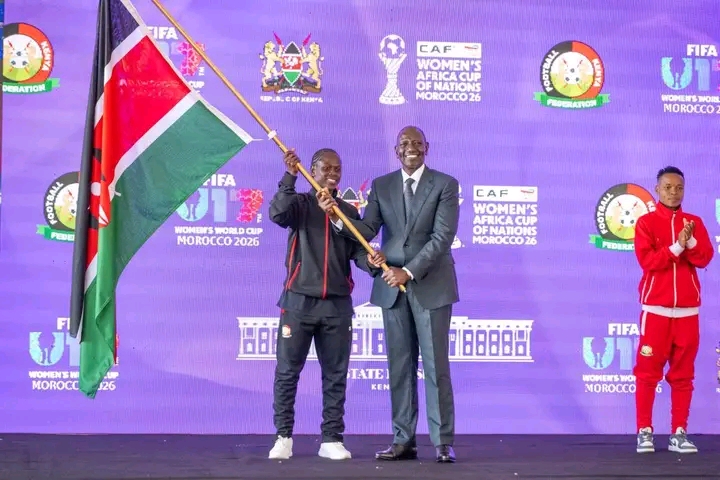
President William Samoei Ruto on Monday presided over the official send-off of the Harambee Starlets and the Junior Starlets at State House, Nairobi, as the two national women’s football teams prepare to fly Kenya’s flag on the continental and global stage in 2026.
The senior women’s team, Harambee Starlets, will represent Kenya at the 2026 Women’s Africa Cup of Nations (WAFCON), while the Junior Starlets are set for the FIFA Under-17 Women’s World Cup in Morocco. The President described the occasion as a proud moment for the country and a reflection of the government’s growing investment in sports and youth development.
“We are proud of their achievements and wish them every success as they represent our nation,” President Ruto said during the ceremony.
Book a Mid-Article Native AdDesktop: Fluid (728x90) · Mobile: Fluid (300x250)The flag-off comes at a time when women’s football in Kenya is gaining unprecedented attention. For years, the Harambee Starlets have fought for recognition, better funding, and competitive opportunities. Qualifying for WAFCON and having a junior team qualify for a FIFA World Cup in the same cycle signals progress.
The Junior Starlets made history as the first Kenyan team, male or female, to qualify for a FIFA World Cup when they played in the U17 edition in 2024. Their return to the global stage in Morocco in 2026 shows that the program is becoming consistent, not a one-off.
For the Starlets, WAFCON 2026 will be a chance to compete against Africa’s best and push for a first-ever World Cup qualification at senior level. President Ruto said the government stands behind both teams and expects them to play with pride, discipline, and determination.
In his remarks, the President linked the teams’ success to deliberate government policy focused on nurturing young talent from the grassroots.
Book a Mid-Article Native AdDesktop: Fluid (728x90) · Mobile: Fluid (300x250)“Their success reflects deliberate investment in youth, talent development and sports,” he noted.
According to the Head of State, more than 10,000 young athletes are currently enrolled in structured development programs run through schools, county governments, and the Kenya Academy of Sports. The aim is to identify talent early, provide coaching, and create a clear pathway from school fields to national teams.
The government has also prioritized capacity building for the people who work behind the scenes. President Ruto said more than 6,000 coaches, trainers, physiotherapists, and sports administrators have undergone specialized training to professionalize how sports are managed and delivered in Kenya.
This dual approach — developing athletes while also upskilling technical staff — is meant to address long-standing gaps that have held back Kenyan sports, including poor preparation, inadequate medical support, and weak administration.
A major part of the sports agenda is infrastructure. The President gave an update on flagship projects that are expected to change how Kenyans train and compete.
Talanta Sports City, the government’s signature stadium project in Nairobi, is now 95 percent complete. Once finished, it is expected to host international matches, athletics events, and serve as a high-performance center for national teams.
In addition, 32 modern stadia are under construction across the country. The county-level facilities are designed to decentralize sports development, ensure young athletes don’t have to travel to Nairobi to access quality pitches, and provide venues for local leagues and tournaments.
“Facilities matter,” President Ruto said. “When a young girl in Kakamega, Kisumu, or Eldoret has a proper stadium to train in, her dream becomes more possible.”
The infrastructure push also ties into Kenya’s ambitions to co-host major tournaments and attract sports tourism. Better facilities mean better preparation, more home games, and more revenue for local economies.
The President also highlighted direct financial support for teams. In the last financial year, the government invested KSh4.5 billion to support national teams. The funding covers key areas such as accommodation, kits, training camps, and travel for both men’s and women’s teams across different sports.
For women’s football specifically, consistent funding has been a historical challenge. Players have previously protested over unpaid allowances and poor logistics. The KSh4.5 billion allocation signals an effort to ensure that teams representing Kenya do so with dignity and proper support.
Sports Cabinet officials present at State House said part of the money has also gone into welfare programs, including insurance and education support for athletes in national teams.
The flag-off of the Starlets and Junior Starlets is more than a ceremonial event. It represents a shift in how the government is approaching sports: as both a social and economic investment.
By giving equal visibility to women’s teams, the administration is signaling that women’s sports will no longer be an afterthought. The Junior Starlets’ World Cup qualification and the Starlets’ WAFCON campaign are being treated with the same seriousness as men’s teams.
With 10,000 youth in development programs and new facilities in counties, the goal is to widen the talent pool. The idea is that the next Harambee Stars or Starlets captain is currently playing in a school tournament in a county stadium.
Sports is also being framed as an employer. Coaches, medics, administrators, kit managers, and event staff are all part of the ecosystem. The training of 6,000 technical personnel is meant to create professional careers around sports.
International tournaments are moments of unity. When the Starlets play at WAFCON or the Junior Starlets take the field in Morocco, millions of Kenyans will be watching. The President urged the teams to play not just for results, but to inspire the next generation.
Both tournaments are still months away, giving the technical teams time to prepare. The Kenya Football Federation, working with the Ministry of Sports, is expected to organize more friendlies, training camps, and exposure tours for both squads.
For the Junior Starlets, the focus will be on building on the experience gained in the last U17 World Cup and ensuring the players are mentally and physically ready for Morocco. For the Starlets, WAFCON 2026 will be about breaking new ground and competing for a World Cup slot.
President Ruto closed by telling the players: “You carry the hopes of a nation. Go and make Kenya proud.”
The State House event drew positive reactions online, with Kenyans congratulating the teams and calling for continued support. Many noted that investment in women’s football has been long overdue and welcomed the infrastructure updates.
As Kenya counts down to 2026, the message from State House is clear: sports is a priority, youth talent is being backed, and the Starlets both senior and junior are expected to carry that vision onto the pitch.
With new facilities coming up, thousands of young athletes in training, and billions shillings committed, the government is betting that this is the beginning of a new era for Kenyan sports —one where success is planned, not accidental.
Comments
No approved comments yet. Be the first to join the conversation.