
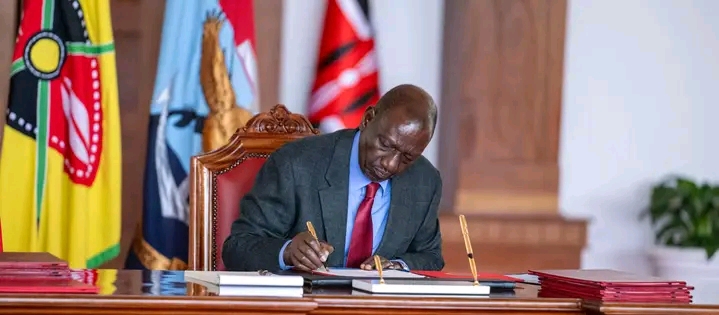
NAIROBI, Kenya 6 July 2026, President William Samoei Ruto on Monday assented to the Central Bank of Kenya (Amendment) Bill, 2026, marking the start of what the government describes as sweeping reforms designed to give the CBK stronger tools to protect financial stability and improve supervision of the banking sector.
The signing ceremony was held at State House, Nairobi, and was witnessed by senior government officials, CBK leadership, and representatives from the financial sector. Photos shared by the President on his official social media platforms showed him appending his signature to the bill at a wooden desk, with the Kenyan flag and other official banners displayed in the background. A second photo captured President Ruto with government officials standing on a red carpet after the assent.
In a statement posted 5 hours ago, President Ruto said the new law was aimed at “strengthening the CBK’s capacity to safeguard financial stability, improve banking oversight” and position Kenya’s financial system to respond to emerging economic challenges.
Book a Mid-Article Native AdDesktop: Fluid (728x90) · Mobile: Fluid (300x250)The post had already attracted more than 7.6K reactions, 667 comments and 248 shares within hours, reflecting significant public interest in the reforms.
While the full details of the amendments are expected to be gazetted in the coming days, the government has indicated that the 2026 law introduces several critical changes to how the Central Bank of Kenya operates and regulates the financial sector.
The amendments are intended to expand CBK’s mandate to identify, monitor and mitigate systemic risks across banks, digital lenders, and other financial institutions. Officials say this will help the regulator act faster during periods of economic stress, currency volatility, or liquidity challenges.
A central focus of the new law is to tighten supervision of commercial banks, microfinance institutions and emerging fintech players. The CBK will have broader powers to conduct stress tests, demand higher capital buffers, and intervene earlier when institutions show signs of distress.
Book a Mid-Article Native AdDesktop: Fluid (728x90) · Mobile: Fluid (300x250)The 2026 amendments are also expected to update the legal framework governing CBK to align it with global best practices. This includes provisions on governance, transparency, and the use of technology in regulation and payments systems.
Sources familiar with the bill say it introduces stronger consumer protection measures, particularly for borrowers dealing with digital lenders and mobile loan apps. The aim is to curb predatory lending while still supporting access to credit for SMEs and low-income Kenyans.
Kenya’s financial sector has undergone rapid transformation in the last decade. Mobile money, digital lending, and cross-border payments have grown exponentially, while global shocks such as inflation, interest rate hikes, and geopolitical tensions have put pressure on banks and borrowers.
Economists say the old CBK Act did not fully anticipate these changes. The 2026 amendments are therefore being positioned as a necessary update to equip the regulator for a more complex and digital financial environment.
Dr. James Mwangi, a financial policy analyst based in Nairobi, said the timing was critical.
“Banks are facing new risks from cyber threats, climate-related exposures, and non-bank financial players. The CBK needs sharper tools to do its job. This amendment gives it that,” he noted.
The government also argues that a stronger CBK will help protect depositors, maintain confidence in the banking system, and make Kenya more attractive to investors. A stable financial sector is key to the administration’s broader economic plan, which targets job creation, affordable credit, and infrastructure financing.
President Ruto signed the bill during a formal ceremony at State House.
Commercial banks will likely face stricter reporting requirements, more frequent audits, and tougher capital adequacy rules. The CBK may also have new powers to approve senior appointments and to take corrective action earlier.
The amendment is expected to bring more digital credit providers under formal CBK supervision. This could mean licensing requirements, interest rate caps, and data protection standards.
Kenyans could see improved protection against unfair lending practices, clearer loan terms, and faster resolution of disputes with financial institutions.
A more resilient banking sector is expected to support lending to businesses, stabilize the shilling, and improve Kenya’s credit rating outlook.
Central Bank Governor Dr. Kamau Thugge, who attended the ceremony, has previously said that modernizing the CBK legal framework is “essential for maintaining trust in our financial system.”
The assent comes as the government continues to push a legislative agenda focused on economic reforms. Earlier this year, Parliament debated several finance-related bills aimed at widening the tax base, improving revenue collection, and reducing public debt.
The CBK Amendment Bill 2026 was passed by both the National Assembly and the Senate after consultations with stakeholders including the Kenya Bankers Association, consumer rights groups, and fintech associations.
President Ruto has repeatedly said that financial stability is a prerequisite for growth. In his post, he framed the new law as part of a broader effort to “safeguard” the economy and ensure that the banking sector serves all Kenyans.
Financial sector stakeholders have largely welcomed the move, though some banks have expressed concern about compliance costs. Consumer groups have called for quick implementation of the consumer protection clauses, especially those targeting digital lenders.
The CBK is expected to issue regulations and guidelines within 90 days to operationalize the new provisions. Training for bank compliance teams and public awareness campaigns are also planned.
With the law now in force, attention will shift to implementation. How effectively the CBK uses its new powers will determine whether the 2026 amendments achieve their goal of a safer, more inclusive, and more resilient financial system.



Comments
No approved comments yet. Be the first to join the conversation.