
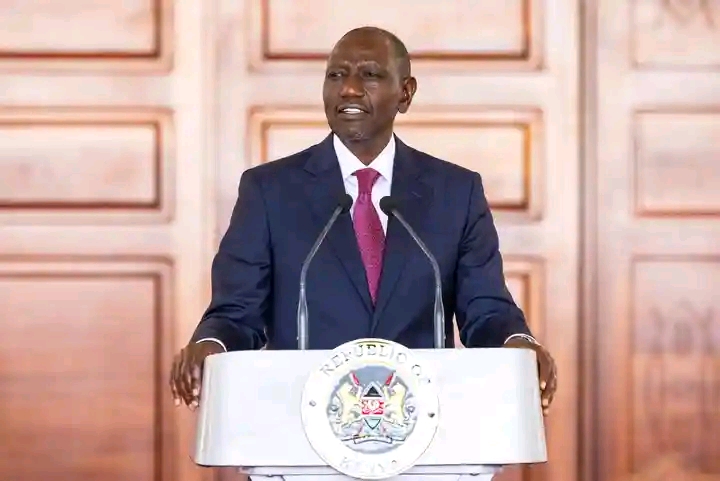
Ruto Says Kenya’s Next Development Chapter Will Be Shaped by Shared Effort as Nation Prepares Beyond Vision 2030

President William Ruto has signaled that Kenya’s next phase of development will demand collective responsibility, not just government action, as the country prepares to move beyond Vision 2030. Receiving a report on strategic guidelines for long-term national transformation at State House, he commended Professor Anyang’ Nyong’o and a team of independent economic scholars for their diligence and patriotism, noting that many of their recommendations align with initiatives already underway such as the National Infrastructure Fund and the Sovereign Wealth Fund. Ruto emphasized that national transformation is a continuous process of reflection and reinvention, and that addressing challenges like youth unemployment, climate vulnerability, and inequality will require the input of citizens, the private sector, civil society, academia, and county governments to ensure growth is both inclusive and sustainable.

Peak Tech Africa

The Signal in 30 seconds

  • President William Samoei Ruto has emphasized that the work of nation building is not something that can be completed and then set aside, but rather an ongoing journey that demands constant self-examination, flexibility, and renewal. In a message shared on his official page, he framed national progress as a process anchored in collective ambition and a steadfast resolve to secure a more prosperous tomorrow for all Kenyans. His remarks came as he received a significant policy document at State House in Nairobi, one that seeks to chart the country’s path forward once the current Vision 2030 framework reaches its conclusion. The report presented to the President contains reflections and proposals meant to serve as strategic guidelines for Kenya’s long-term transformation. Vision 2030, which has guided national planning for nearly two decades, set out ambitious goals to transform Kenya into a newly industrializing, middle-income country with a high quality of life for its citizens by the year 2030. With that target now approaching, the government has begun looking ahead to what comes next, and the document handed over at State House is intended to help shape that next phase. Ruto took time to publicly acknowledge the individuals behind the report, singling out Professor Anyang’ Nyong’o, the Governor of Kisumu, and the team of independent economic experts who worked alongside him. He praised them for their commitment, scholarly depth, and sense of duty to the country. According to the President, the preparation of the report reflected not only technical competence but also a patriotic spirit, as the team sought to offer ideas that could serve the broader public good rather than narrow interests. The recognition underscores the administration’s stated intention to draw on expertise from across the country, including leaders at the county level and academics operating outside government, in shaping national policy. A key point in the President’s message was the alignment he sees between many of the recommendations in the report and initiatives his administration has already set in motion. He specifically referenced the creation of the National Infrastructure Fund and the Sovereign Wealth Fund as examples of programs that mirror the forward-looking thinking contained in the new proposals. These two funds are central to the government’s economic agenda. The National Infrastructure Fund is designed to mobilize resources for large-scale projects in transport, energy, housing, and digital connectivity, areas seen as critical to unlocking productivity and reducing the cost of doing business. The Sovereign Wealth Fund, on the other hand, is intended to manage and invest revenues from natural resources and other strategic assets, with the goal of saving for future generations while also providing capital for development today. Beyond those two, Ruto noted that the report contains other transformative proposals aimed at driving development that is both inclusive and sustainable. The emphasis on inclusivity suggests a focus on ensuring that growth does not leave behind rural communities, young people, women, and marginalized groups, while sustainability points to the need to balance economic expansion with environmental stewardship and fiscal responsibility. The administration has repeatedly argued that Kenya cannot afford a development model that delivers growth in the short term at the expense of long-term resilience, and the language in the President’s statement reflects that position. Perhaps the most important assertion in the message was that the next stage of Kenya’s development cannot be the responsibility of government alone. Ruto made it clear that writing the next chapter of the country’s story will require the participation of citizens, the private sector, civil society, academia, and county governments. This is a departure from the idea that development is something delivered top-down by the state. Instead, it frames transformation as a shared project in which different actors bring resources, ideas, and accountability to the table. The call for collective ownership is significant because many of the challenges Kenya faces, from youth unemployment to climate vulnerability to regional inequality, are too complex for any single institution to solve in isolation. The timing of the report’s submission is also noteworthy. As Vision 2030 nears its final years, there has been growing public debate about what should replace it and how to avoid a policy vacuum. Some critics have argued that Kenya needs a more pragmatic, results-oriented framework that learns from the successes and shortcomings of the last two decades. Others have stressed the importance of continuity, saying that abandoning long-term planning would undermine investor confidence and disrupt ongoing projects. By receiving and engaging with a report on “beyond Vision 2030” now, the government appears to be signaling that it wants an early and deliberate conversation about the future, rather than waiting until the last minute. Professor Nyong’o’s role in leading the team is itself symbolic. As both an academic and an elected governor, he represents the intersection of research and practical governance. Kisumu, the county he leads, has been one of the focal points for regional development initiatives, including port revitalization and special economic zones, and his involvement may help ensure that the national strategy pays closer attention to how policies play out at the county level. The inclusion of independent scholars also suggests an effort to bring in perspectives that are not bound by day-to-day political considerations. The broader message from State House is that transformation is not a single event or a checklist to be completed. It is described as a continuous cycle of looking back to learn, adjusting to new realities, and reinventing approaches when circumstances change. That framing acknowledges that Kenya, like other countries, operates in a volatile global environment where economic shocks, technological change, and climate pressures require constant adaptation. It also places aspirations at the center of the process, suggesting that technical plans must be connected to what Kenyans hope for their families and communities. If the themes in the report do indeed resonate with what the government is already doing, then the next step will be to translate that alignment into concrete action and legislation. Funds like the National Infrastructure Fund and Sovereign Wealth Fund will need clear governance structures, transparent management, and measurable outcomes if they are to deliver on their promise. Similarly, any new long-term strategy will need to be communicated widely so that it does not remain a document in government offices but becomes a reference point for businesses, schools, and local communities. In closing, the President’s statement presents national transformation as both an idea and a practice. As an idea, it is guided by shared aspirations for a better future. As a practice, it requires reflection on what has worked, adaptation to new challenges, and reinvention of old models. With the submission of the report on strategic guidelines beyond Vision 2030, Kenya is beginning the process of defining what comes next. The emphasis now appears to be on ensuring that this next phase is built not only in government offices, but through a wider partnership that includes experts like Professor Nyong’o and his team, county leaders, and ultimately the Kenyan people themselves. The road ahead is framed not as a destination already mapped, but as a path that will continue to be shaped by choices made today.

President William Samoei Ruto has emphasized that the work of nation building is not something that can be completed and then set aside, but rather an ongoing journey that demands constant self-examination, flexibility, and renewal. In a message shared on his official page, he framed national progress as a process anchored in collective ambition and a steadfast resolve to secure a more prosperous tomorrow for all Kenyans. His remarks came as he received a significant policy document at State House in Nairobi, one that seeks to chart the country’s path forward once the current Vision 2030 framework reaches its conclusion.

The report presented to the President contains reflections and proposals meant to serve as strategic guidelines for Kenya’s long-term transformation. Vision 2030, which has guided national planning for nearly two decades, set out ambitious goals to transform Kenya into a newly industrializing, middle-income country with a high quality of life for its citizens by the year 2030. With that target now approaching, the government has begun looking ahead to what comes next, and the document handed over at State House is intended to help shape that next phase.

Ruto took time to publicly acknowledge the individuals behind the report, singling out Professor Anyang’ Nyong’o, the Governor of Kisumu, and the team of independent economic experts who worked alongside him. He praised them for their commitment, scholarly depth, and sense of duty to the country. According to the President, the preparation of the report reflected not only technical competence but also a patriotic spirit, as the team sought to offer ideas that could serve the broader public good rather than narrow interests. The recognition underscores the administration’s stated intention to draw on expertise from across the country, including leaders at the county level and academics operating outside government, in shaping national policy.

A key point in the President’s message was the alignment he sees between many of the recommendations in the report and initiatives his administration has already set in motion. He specifically referenced the creation of the National Infrastructure Fund and the Sovereign Wealth Fund as examples of programs that mirror the forward-looking thinking contained in the new proposals. These two funds are central to the government’s economic agenda. The National Infrastructure Fund is designed to mobilize resources for large-scale projects in transport, energy, housing, and digital connectivity, areas seen as critical to unlocking productivity and reducing the cost of doing business. The Sovereign Wealth Fund, on the other hand, is intended to manage and invest revenues from natural resources and other strategic assets, with the goal of saving for future generations while also providing capital for development today.

Peak Tech Africa

Beyond those two, Ruto noted that the report contains other transformative proposals aimed at driving development that is both inclusive and sustainable. The emphasis on inclusivity suggests a focus on ensuring that growth does not leave behind rural communities, young people, women, and marginalized groups, while sustainability points to the need to balance economic expansion with environmental stewardship and fiscal responsibility. The administration has repeatedly argued that Kenya cannot afford a development model that delivers growth in the short term at the expense of long-term resilience, and the language in the President’s statement reflects that position.

Perhaps the most important assertion in the message was that the next stage of Kenya’s development cannot be the responsibility of government alone. Ruto made it clear that writing the next chapter of the country’s story will require the participation of citizens, the private sector, civil society, academia, and county governments. This is a departure from the idea that development is something delivered top-down by the state. Instead, it frames transformation as a shared project in which different actors bring resources, ideas, and accountability to the table. The call for collective ownership is significant because many of the challenges Kenya faces, from youth unemployment to climate vulnerability to regional inequality, are too complex for any single institution to solve in isolation.

The timing of the report’s submission is also noteworthy. As Vision 2030 nears its final years, there has been growing public debate about what should replace it and how to avoid a policy vacuum. Some critics have argued that Kenya needs a more pragmatic, results-oriented framework that learns from the successes and shortcomings of the last two decades. Others have stressed the importance of continuity, saying that abandoning long-term planning would undermine investor confidence and disrupt ongoing projects. By receiving and engaging with a report on “beyond Vision 2030” now, the government appears to be signaling that it wants an early and deliberate conversation about the future, rather than waiting until the last minute.

Professor Nyong’o’s role in leading the team is itself symbolic. As both an academic and an elected governor, he represents the intersection of research and practical governance. Kisumu, the county he leads, has been one of the focal points for regional development initiatives, including port revitalization and special economic zones, and his involvement may help ensure that the national strategy pays closer attention to how policies play out at the county level. The inclusion of independent scholars also suggests an effort to bring in perspectives that are not bound by day-to-day political considerations.

Peak Tech Africa

The broader message from State House is that transformation is not a single event or a checklist to be completed. It is described as a continuous cycle of looking back to learn, adjusting to new realities, and reinventing approaches when circumstances change. That framing acknowledges that Kenya, like other countries, operates in a volatile global environment where economic shocks, technological change, and climate pressures require constant adaptation. It also places aspirations at the center of the process, suggesting that technical plans must be connected to what Kenyans hope for their families and communities.

If the themes in the report do indeed resonate with what the government is already doing, then the next step will be to translate that alignment into concrete action and legislation. Funds like the National Infrastructure Fund and Sovereign Wealth Fund will need clear governance structures, transparent management, and measurable outcomes if they are to deliver on their promise. Similarly, any new long-term strategy will need to be communicated widely so that it does not remain a document in government offices but becomes a reference point for businesses, schools, and local communities.

In closing, the President’s statement presents national transformation as both an idea and a practice. As an idea, it is guided by shared aspirations for a better future. As a practice, it requires reflection on what has worked, adaptation to new challenges, and reinvention of old models. With the submission of the report on strategic guidelines beyond Vision 2030, Kenya is beginning the process of defining what comes next. The emphasis now appears to be on ensuring that this next phase is built not only in government offices, but through a wider partnership that includes experts like Professor Nyong’o and his team, county leaders, and ultimately the Kenyan people themselves. The road ahead is framed not as a destination already mapped, but as a path that will continue to be shaped by choices made today.
Share this story

About the author

S

Simon Simiyu

Kenya Signal Room Contributor

Writer with 3+ years crafting SEO and brand copy for blogs, websites, and email. I turn research into clear, human stories that rank and convert. Fast, reliable, and picky about g…

View author profile

Corrections & updates

Kenya Signal Room corrects factual errors promptly. To request a correction, contact the editorial team through our contact page.

Stay in the Signal

Get the morning brief: 5 stories, 1 explainer, and the county signal to watch.

Know something we should investigate?

Send a verified tip, document, photo or story idea to Kenya Signal Room.

Submit a Tip
Peak Tech Africa

Comments

No approved comments yet. Be the first to join the conversation.

Comments appear after admin approval.