
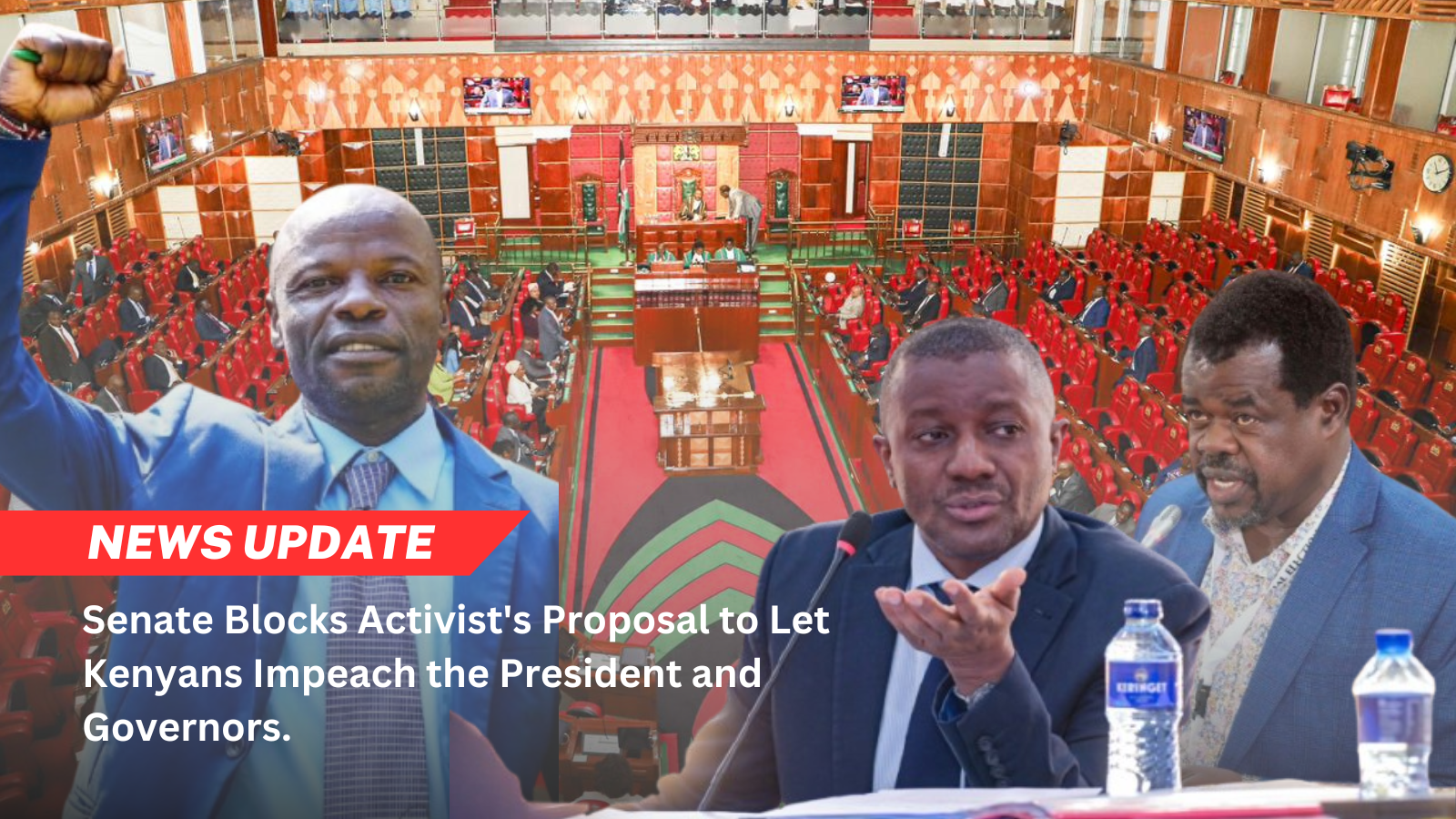
The Kenyan Senate has rejected a public petition by Nakuru-based activist Laban Omusundi seeking the establishment of a legal framework that would allow citizens to directly Impeach the President and County Governors from office.
Omusundi prepared the petition on September 1, 2025, arguing that the current constitutional framework does not give citizens the power to directly remove top executive leaders who violate the Constitution, abuse public office, or engage in gross misconduct. The petition was formally tabled in the Senate by Speaker Amason Kingi on February 12, 2026, before being referred to the Senate Standing Committee on Justice, Legal Affairs and Human Rights (JLAHRC) for consideration.
In his submission, Omusundi argued that the existing system leaves the country vulnerable to impunity whenever Parliament fails to effectively exercise its oversight role. He proposed a legal mechanism that would allow registered voters to initiate verified recall petitions against the President or County Governors where there is evidence of constitutional violations, abuse of office, or gross misconduct. According to the petitioner, such a framework would strengthen accountability by restoring greater sovereignty to the people.
Book a Mid-Article Native AdDesktop: Fluid (728x90) · Mobile: Fluid (300x250)The proposal generated mixed reactions among members of the committee. Senator Daniel Maanzo supported the petition, noting that it would provide citizens with an alternative accountability mechanism in situations where Parliament is unable or unwilling to impeach a leader. He observed that removing a President through a "captured Parliament" can be extremely difficult.
However, Senators Okiya Omtatah and Prof. Tom Ojienda expressed reservations, arguing that introducing a direct recall process would fundamentally alter Kenya's constitutional structure. They maintained that the Constitution clearly assigns the responsibility of holding the executive accountable to Parliament and County Assemblies, warning that such a proposal could undermine the existing system of checks and balances.
Under Article 145 of the Constitution, the President can only be removed through an impeachment process initiated in Parliament. The process begins in the National Assembly, where an impeachment motion must be supported by at least one-third of all Members of Parliament and later approved by a two-thirds majority. Once passed, the matter is forwarded to the Senate, which investigates the allegations before conducting a final vote. The President is removed from office only if at least two-thirds of all Senators uphold any of the impeachment charges.
After reviewing the petition, the Justice, Legal Affairs and Human Rights Committee concluded that Parliament lacks the constitutional authority to enact an ordinary law allowing citizens to directly recall the President or County Governors. The committee explained that under Kenya's constitutional architecture, direct recall mechanisms are reserved exclusively for elected legislators, including Members of Parliament and Members of County Assemblies, because they are not subject to oversight by another elected institution.
Book a Mid-Article Native AdDesktop: Fluid (728x90) · Mobile: Fluid (300x250)The committee's report, which was moved by Senator Daniel Maanzo, stated that introducing a citizen-led recall mechanism for executive office holders would fundamentally change the Constitution's accountability framework. As a result, the Senate rejected the petition, while commending Omusundi for demonstrating active public participation and commitment to constitutional governance.
The Senate further advised that if Omusundi wishes to pursue the proposal, he should initiate a constitutional amendment through a popular initiative under Articles 255 and 257 of the Constitution. Such a process requires the collection of at least one million signatures from registered voters before the proposal can proceed through the constitutional amendment process.
The decision means that, under the current Constitution, the authority to remove the President through impeachment remains exclusively with Parliament, while any attempt to introduce direct citizen-led recalls must first be achieved through a constitutional amendment.



Comments
No approved comments yet. Be the first to join the conversation.